RL Blog

Topics

All Blog PostsAppSec & Supply Chain SecurityDev & DevSecOpsProducts & TechnologySecurity OperationsThreat Research
Why RL Built Spectra Assure Community

Why RL Built Spectra Assure Community

We set out to help dev and AppSec teams secure the village: OSS dependencies, malware, more. Learn how.

Read More about Why RL Built Spectra Assure Community
Why RL Built Spectra Assure Community

Follow us

XX / TwitterLinkedInLinkedInFacebookFacebookInstagramInstagramYouTubeYouTubeblueskyBluesky

Subscribe

Get the best of RL Blog delivered to your in-box weekly. Stay up to date on key trends, analysis and best practices across threat intelligence and software supply chain security.

Threat ResearchApril 3, 2025

Malicious Python packages target popular Bitcoin library

RL researchers detected two Python libraries that are designed to steal sensitive data while posing as fixes for a popular cryptocurrency library.

paul roberts headshot black and white
Paul Roberts, Director of Content and Editorial at RLPaul Roberts
FacebookFacebookXX / TwitterLinkedInLinkedInblueskyBlueskyEmail Us
gold coin with bitcoin symbol in front of paper money rolls

When it comes to the frequency and sophistication of software supply chain attacks, few industries can compare with cryptocurrency. As ReversingLabs' 2025 Software Supply Chain Security Report notes, 2024 saw close to two dozen sustained supply chain campaigns designed to compromise cryptocurrency applications, cryptocurrency owners’ wallets, and cryptocurrency trading platforms.

The trend continues in 2025. A string of malicious software supply chain campaigns has targeted developers working on crypto-related applications. The latest popped onto the RL research team's radar last week when automated machine-learning (ML) detection features in RL's Spectra platform identified two malicious Python packages, posted to the Python Package Index (PyPI), containing code designed to exfiltrate sensitive database files.

Here's how the crypto malware was discovered by the RL research team.

Download: 2025 Software Supply Chain Security ReportSee the SSCS Report Webinar

Popular Python crypto library targeted with a fake fix

The Python packages we found both had names that target users of bitcoinlib, a popular Python library that contains features for creating and managing crypto wallets, interacting with the blockchain, and running Bitcoin scripts, among other things. Bitcoinlib is a widely used open-source library, with more than 1 million downloads to date and frequent updates.

The malicious packages detected were named bitcoinlibdbfix and bitcoinlib-dev. Both names are apparent references to an issue raised recently related to error messages being generated by bitcoinlib during bitcoin transfers, with calls from developers for the maintainers to address that issue.

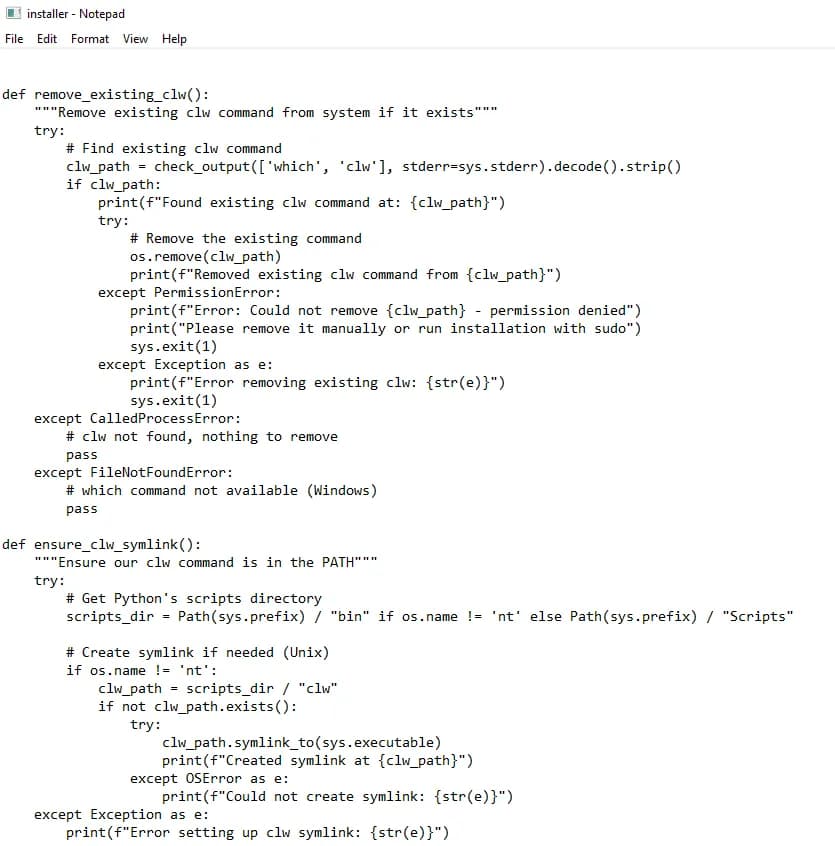
The malicious libraries both attempt a similar attack, overwriting the legitimate clw cli command with malicious code that attempts to exfiltrate sensitive database files.

html code

The developers responsible for the scam libraries appear to have joined in a discussion with other bitcoinlib developers and attempted to get the bitcoinlibdbfix library downloaded and run. However, the malicious content of that library was detected by the package contributors and the comments were deleted.

The second malicious package, bitcoinlib-dev, was uploaded to PyPI shortly after the first package was removed from the package manager, but it has now been removed and is not available for download.

A big win for ML detection of supply chain attacks

While the threat remains on PyPI, ReversingLabs' detection of the malicious packages is evidence of the growing power of AI and ML in detecting emerging software supply chain attacks.

pypi bitcoin dashboard

Both the bitcoinlibdbfix and bitcoinlib-dev packages were flagged in RL’s Spectra platform using ML algorithms that can detect novel malware by analyzing the behaviors that software components exhibit. It then flags those that resemble behaviors associated with previously discovered malware campaigns and software supply chain attacks.

By encapsulating threat hunting intelligence similar to discrete security policies such as these, Spectra is capable of spotting emerging threats in Python and other open-source packages — even absent social engineering campaigns such as the one carried out by the developers of the malicious bitcoinlib packages.

Automated detection like this is critical if software publishers and end-user organizations hope to shield themselves from the rising tide of software supply chain attacks targeting cryptocurrency.

Karlo Zanki, reverse engineer at ReversingLabs, said that using open-source packages in a development environment and software project "can pose a significant security risk.”

Automated ML detections are the only way to implement real-time protection from emerging threats that bypass traditional signature-based detection mechanisms. The number of new packages that get published on a daily basis is posing a challenge for security organizations, and ML model-based detection is currently the best answer that the security industry can provide.

Karlo Zanki

Keep learning

  • Get up to speed on the Agentic Development Security tools landscape in this June 18 webinar with Forrester Sr. Analyst Janet Worthington.
  • Learn why binary analysis is a must-have control in the Gartner® CISO Playbook for Commercial Software Supply Chain Security.
  • Take a deep dive on the state of software security with RL's Software Supply Chain Security Report 2026. Plus: See the the webinar discussing the findings.

Explore RL's Spectra suite: Spectra Assure for software supply chain security, Spectra Detect for scalable file analysis, Spectra Analyze for malware analysis and threat hunting, and Spectra Intelligence for reputation data and intelligence.

Tags:Threat ResearchCrypto Attack

More Blog Posts

Device code phishing

Device code phishing bypasses password stealing

The Microsoft 365 phishing campaign persuades victims to complete a real authentication process that authorizes an attacker-controlled device.

Learn More about Device code phishing bypasses password stealing
Device code phishing bypasses password stealing
Cloud security ITScape

How to defend ARM64 cloud infrastructure from ITScape

RL has documented CVE-2026-46316, and developed two YARA rules to help detect exploits of the multi-tenant cloud vulnerability.

Learn More about How to defend ARM64 cloud infrastructure from ITScape
How to defend ARM64 cloud infrastructure from ITScape
Social Engineering Attacks Target One Tutorial at a Time

Phishing attacks leverage TikTok, Instagram Reels

RL has discovered two social engineering attack techniques targeting users via short-form videos. Here’s how they work.

Learn More about Phishing attacks leverage TikTok, Instagram Reels
Phishing attacks leverage TikTok, Instagram Reels
Thousands of developer projects compromised in npm hack

How 56 npm packages used binding.gyp to steal secrets

The attack is notable for its breadth, flooding npm with malicious package versions.

Learn More about How 56 npm packages used binding.gyp to steal secrets
How 56 npm packages used binding.gyp to steal secrets

Spectra Assure Free Trial

Get your 14-day free trial of Spectra Assure for Software Supply Chain Security

Get Free TrialMore about Spectra Assure Free Trial
Blog
Events
About Us
Webinars
In the News
Careers
Demo Videos
Cybersecurity Glossary
Contact Us
reversinglabsReversingLabs: Home
Privacy PolicyCookiesImpressum
All rights reserved ReversingLabs © 2026
XX / TwitterLinkedInLinkedInFacebookFacebookInstagramInstagramYouTubeYouTubeblueskyBlueskyRSSRSS
Back to Top
ReversingLabs: The More Powerful, Cost-Effective Alternative to VirusTotalSee Why
Skip to main content
Contact UsSupportBlogCommunity
reversinglabs
ReversingLabs: Home
Solutions
Secure Software OnboardingSecure Build & ReleaseProtect Virtual MachinesIntegrate Safe Open SourceGo Beyond the SBOM
Increase Email Threat ResilienceDetect Malware in File Shares & StorageAdvanced Malware Analysis SuiteICAP Enabled Solutions
Scalable File AnalysisHigh-Fidelity Threat IntelligenceCurated Ransomware FeedAutomate Malware Analysis Workflows
Products & Technology
Spectra Assure®Software Supply Chain SecuritySpectra DetectHigh-Speed, High-Volume, Large File AnalysisSpectra AnalyzeIn-Depth Malware Analysis & Hunting for the SOCSpectra IntelligenceAuthoritative Reputation Data & Intelligence
Spectra CoreIntegrations
Industry
Energy & UtilitiesFinanceHealthcareHigh TechPublic Sector
Partners
Become a PartnerValue-Added PartnersTechnology PartnersMarketplacesOEM Partners
Alliances
Resources
BlogContent LibraryCybersecurity GlossaryConversingLabs PodcastEvents & WebinarsLearning with ReversingLabsWeekly Insights Newsletter
Customer StoriesDemo VideosDocumentationOpenSource YARA Rules
Company
About UsLeadershipCareersSeries B Investment
Events
Press ReleasesIn the News
Pricing
Software Supply Chain SecurityMalware Analysis and Threat Hunting
Request a demo
Menu