Spectra Assure Free Trial
Get your 14-day free trial of Spectra Assure for Software Supply Chain Security
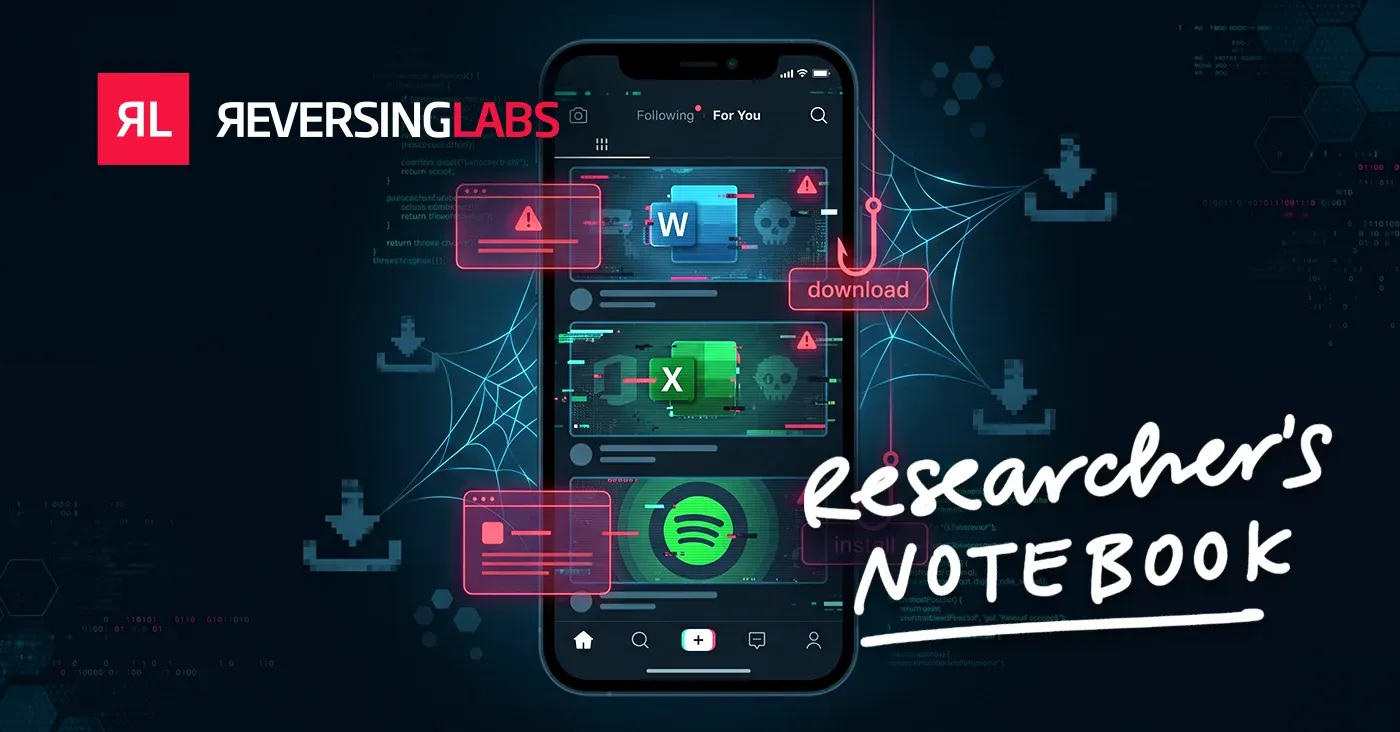
Get Free TrialMore about Spectra Assure Free TrialShort-form videos on social media apps are currently being leveraged by threat actors as a phishing vector, utilizing tutorial style content with the promise of free premium software to lure victims onto malicious sites.
This is an important threat to be cognizant of, as the videos can trick users into directly downloading malware. In order to best defend organizations, steps can be taken to mitigate the risks associated with these videos, both in user training and technical guardrails.
Here’s what these malicious videos look like, how they work — and why they are so successful. ReversingLabs (RL) analyzed the phenomena’s two distinct campaigns, which both managed to reach a large audience by leveraging different metrics to game the content recommendation algorithms.
If you’ve used social media, you know that sometimes it recommends solutions to problems you never thought about solving. Most of the time, you don’t need these problems solved, but sometimes you stumble across something actually useful. Someone offers you an easy way to get free software, like Spotify Premium or Microsoft Word. The video looks like everything else you’ve seen during your scroll, and those thousands of views and hundreds of likes have to count for something.
Unfortunately the algorithm and your trust in social media has signed you up for malware, with the likes of Vidarstealer on the table. The tutorial was too good to be true and now a mess is on your hands.
During RL researcher’s investigation of malicious social media videos, two different lure techniques were observed across accounts and social media platforms. Primarily conducted on TikTok and Instagram Reels, these campaigns use the same template to mass produce videos and make regular posts. Either approach is a means to a different end, and the differences demonstrate how attackers can leverage different aspects of social media engagement to reach more potential victims.
One methodology involves fake tutorials for software installs, with professional sounding voice overs and clean graphics. The second approach relies on posts demonstrating how to use premium software for free, spanning multiple videos, with a centralized tutorial being introduced after the account gains traction. Regardless of the differing hooks, both campaign tactics seek to drive viewers to a secondary website hosting free software of dubious intent.
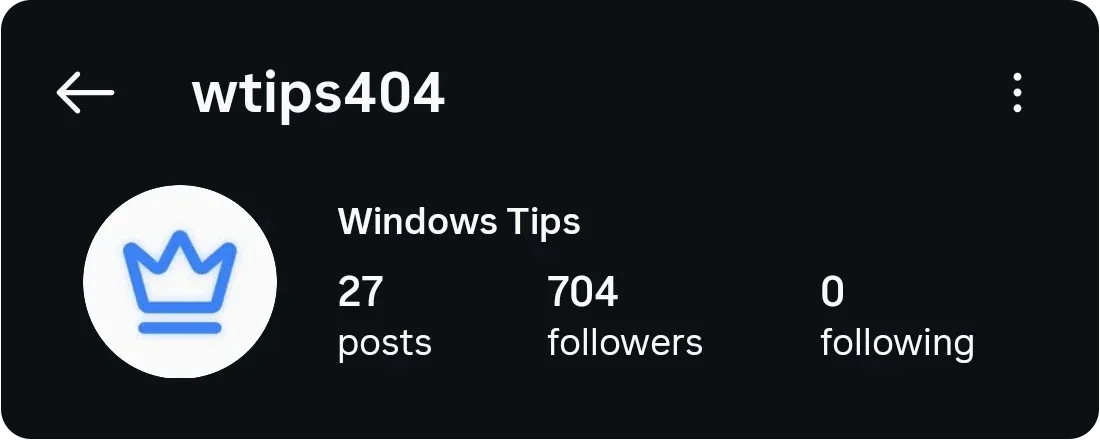
The malicious tutorial campaigns come from a myriad of almost identical accounts, with usernames like “windows.tips” or “windows.insights” and the same blue and white profile picture.
Figure 1.1, screenshot of the malicious user, showing their profile picture: A blue outline of a crown on a white background.
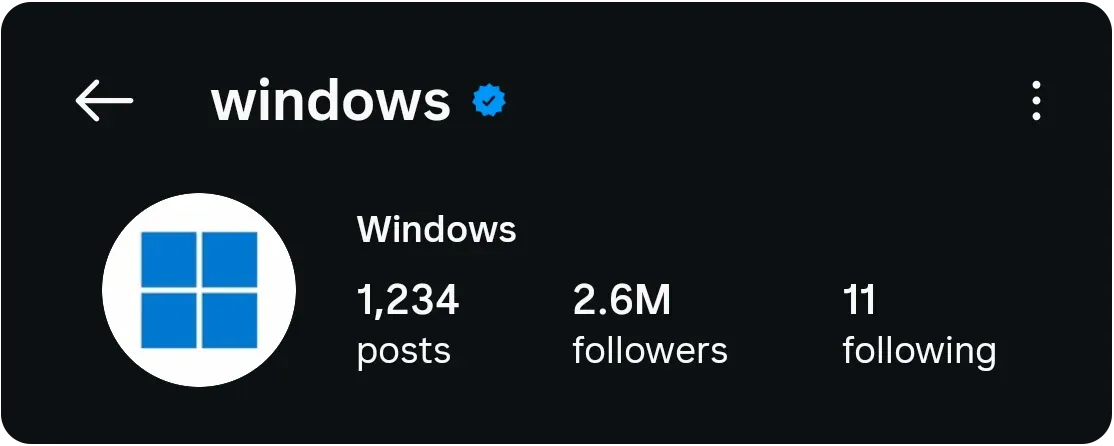
The profile picture uses this color palette to mirror the legitimate Window’s social media account’s icon. This may help establish credibility for the malicious account.
Figure 1.2, screenshot of the official windows account, showing their profile picture: A blue Windows logo on a white background.
The videos utilize descriptions and tags to make them seem like legitimate customer support pages.
Figure 1.3, image showing the various search tags utilized by the malicious account.
Here is an example of what one of their tutorials may look like.
In this video, a potentially AI-generated voice reads out simple directions to unlock Spotify Premium. The video is short and to the point, showing users step-by-step how to access Powershell from the Windows menu, and what command to input to supposedly unlock this free service. A non-technical user does not know any better, and may assume it is legitimate. Attackers are relying on this lack of understanding. The iex irm command will download scripts present at the specified address, and some users may believe the msget[.]run/spotify is a Microsoft-affiliated or otherwise legitimate domain. Social media users executing this command may trust the video on face value, without verifying what is being downloaded when they run this command.
What makes the video dangerous is how clean and professional it is, creating a false sense of authority. Tutorials are frequently liked and saved, as users want to save them for later viewing. Saving is a very valuable interaction to posts, and the act causes the social media platform algorithm to push the content to more users. Users may also share the tutorial, creating more engagement which the content serving algorithm favors. Highly successful videos have many likes, shares and saves.
The following video is one such example, with over 100,000 views and thousands of interactions. Most users default to liking videos, which makes it a milder indicator of quality to the algorithm as opposed to the more selectively used save, share and comment. The fact the following video has nearly 200 more saves as opposed to likes proves how threat actors are targeting the more algorithmically valuable form of engagement through these videos.
Figure 1.4, Image of video with 1,699 saves, 1,581likes, and 974 shares. Not shown on this screen is that the video has 109,000 views.
In the case a user does follow the directions described in the video tutorial, they will most likely end up with an unfortunate surprise on their device. Researchers extracted the executable at the msget[.]run/spotify domain, and used ReversingLabs Spectra Analyze for a deeper look.
Figure 1.5, Spectra Analyze results for the executable from the msget[.]run domain.
The build.exe file delivered through this command is identified as Vidarstealer, confirming other reports of this phenomenon. Vidarstealer is a popular infostealer malware as a service (MaaS) offering which steals credentials, financial information, and tokens from victims. It is a long standing malware that was updated in October of last year, making it more evasive and stable. With an affordable $300 lifetime license, it is a much-used tool by malicious actors. This can be seen with its usage across various campaigns, like fake game cheats, malvertising, and more. The attackers using this malware seem to be targeting a variety of demographics and regions, with many targets being individual users. The ease of use of MaaS combines with the accessibility of social media as a vector, making a dangerous combination.
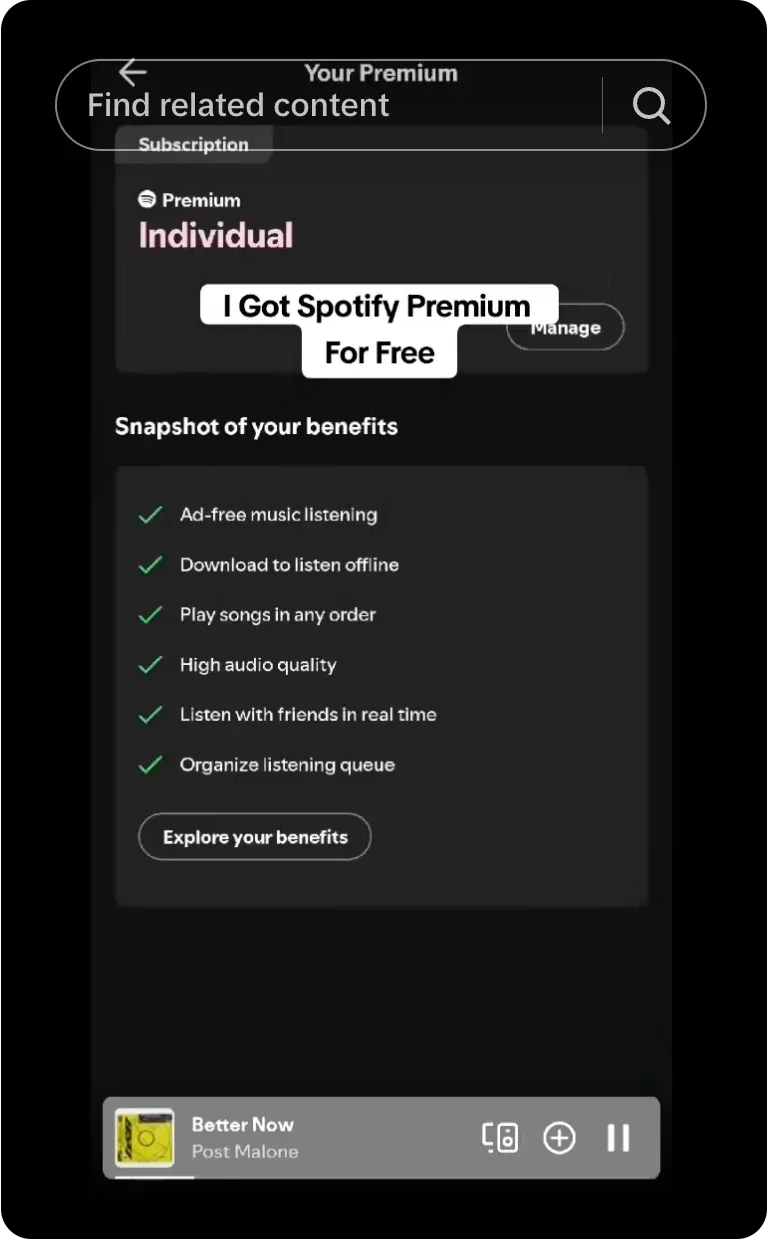
The second type of video found has a completely different approach. Gone is the professionalism. Now, the focus is short videos blasting trending music while scrolling through the features of premium software, mainly Spotify Premium. There is text on screen, which usually claims they got these premium features for free. This video category is posted by accounts that look like a typical user. However, their library of posts consist entirely of copy/paste videos solely about their free Spotify Premium experience.
Figure 2.1, screenshot of videos of the Spotify app with the caption, as seen in a sample lure video posted on TikTok.
It seems strange upon first glance, but one look into the comment section reveals their goal. These vague videos get users to ask questions, pondering how the poster was able to get free access to the program. It is a natural aspect of human curiosity. Unfortunately, this curiosity plays right into what the attacker wants. This becomes more evident with some of the videos, which encourage users to comment with certain phrases.
Figure 2.2, Screenshot of video encouraging users to comment “ok”.
This commenting strategy is used by non-malicious creators, such as recipe writers, to help build engagement and foster an audience relationship. After viewers comment, the creator messages or replies with directions. Attackers use this technique and trust in it to provide directions to dangerous sites. If not using the previously mentioned comment reply approach, they will redirect users to a separate tutorial video or a link in their account description, in order to funnel victims to malicious sites. Regardless of how the tutorial is delivered, the content strategy revolves around generating user comments for engagement to boost videos, then building a rapport before providing the malicious tutorial.
Once the attacker gathers the interest from their audience, they release the coveted techniques. This involves links to sites advertised to contain the free software downloads. Some of these sites, like pluginchad[.]xyz or maxapk[.]xyz, have been taken down. However, researchers were able to explore the d4ug[.]site (now inactive) using Spectra Analyze’s Interactive Sandbox.
Figure 2.3, D4ug[.]site, which claims to “Unlock premium games & AI tools”. Some examples of the offerings are Spotify Premium, CapCut Pro, and YouTube Premium.
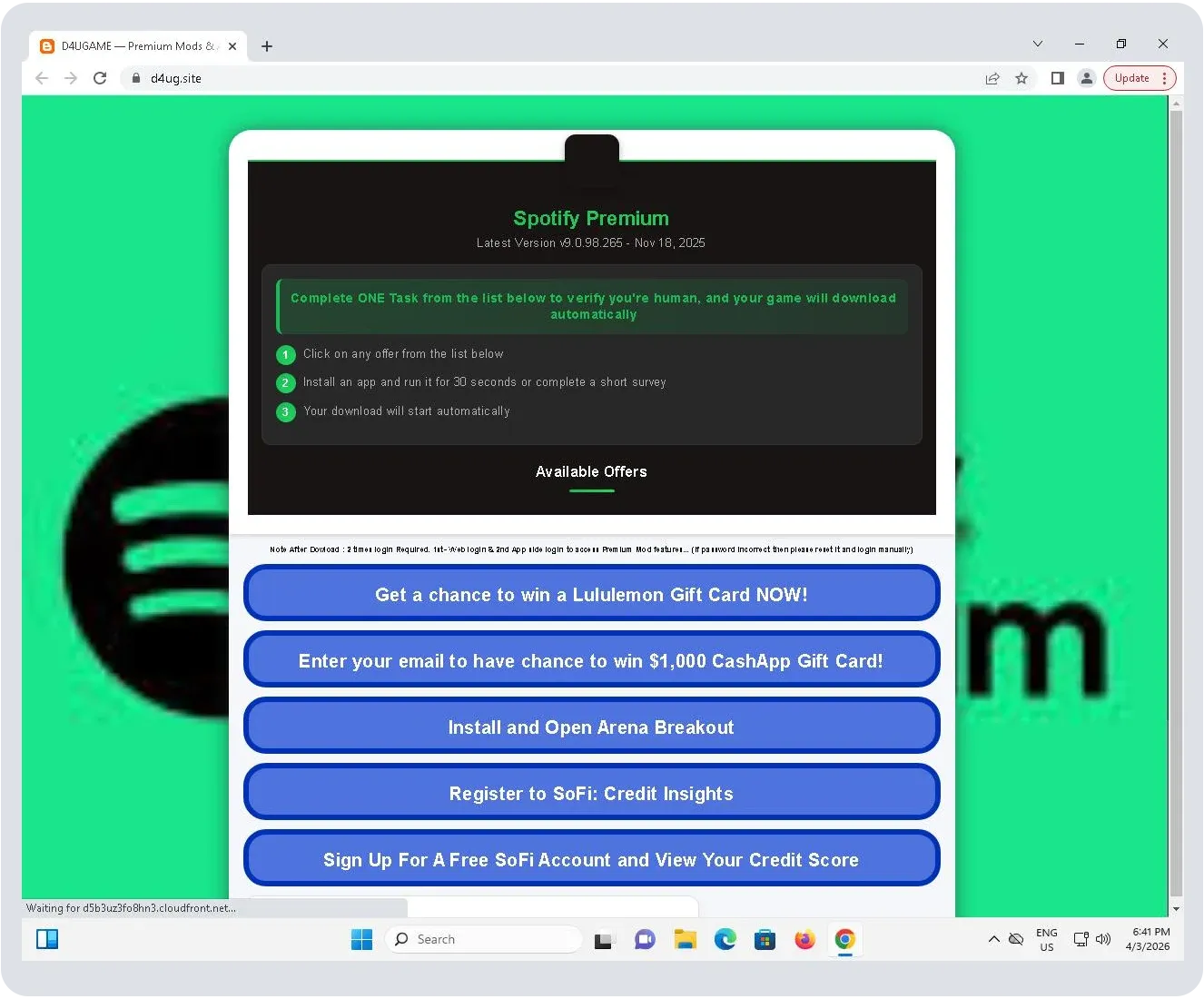
The website has many offerings of memberships and software. Clicking the Spotify Premium option brings up the screen below.
Figure 2.3, Download screen for Spotify Premium, with a list of 5 tasks to do to unlock the download.
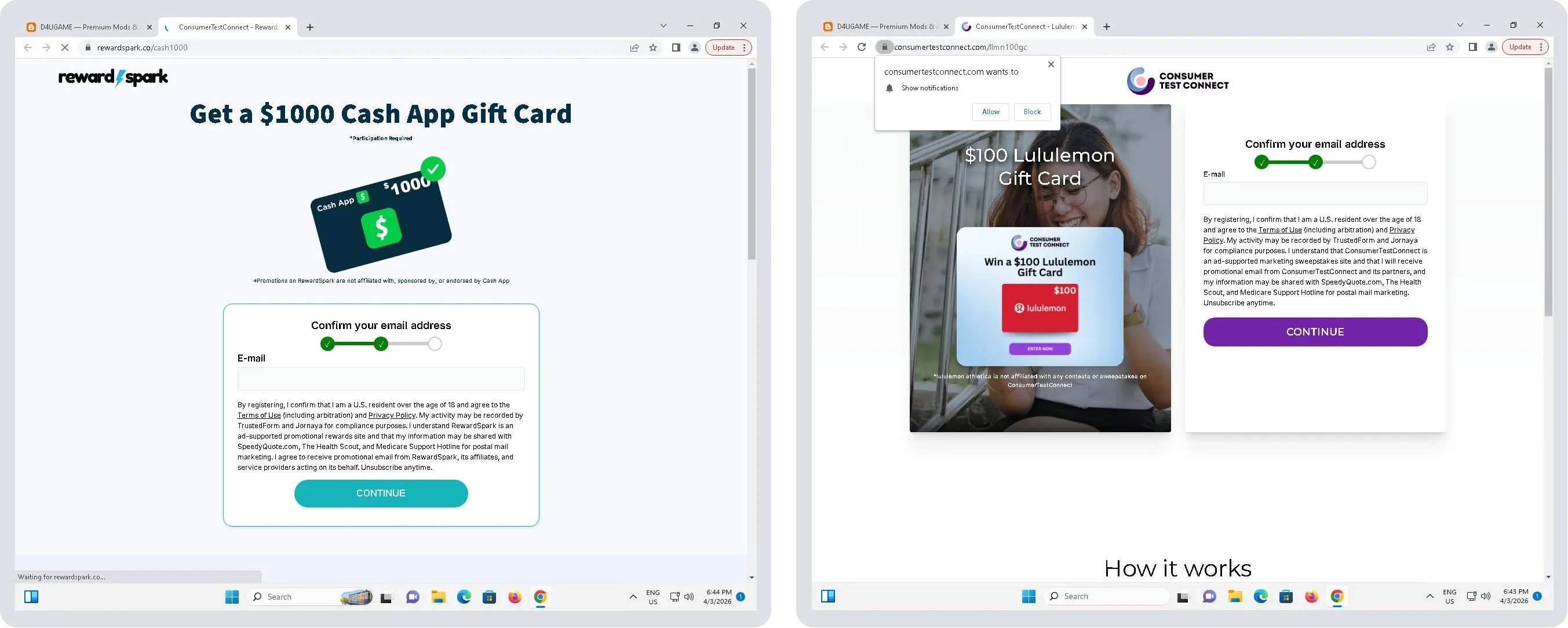
The first two options were attempted, leading to surveys:
Figures 2.4.1 and 2.4.2, the first page of two surveys, advertising free gift cards.
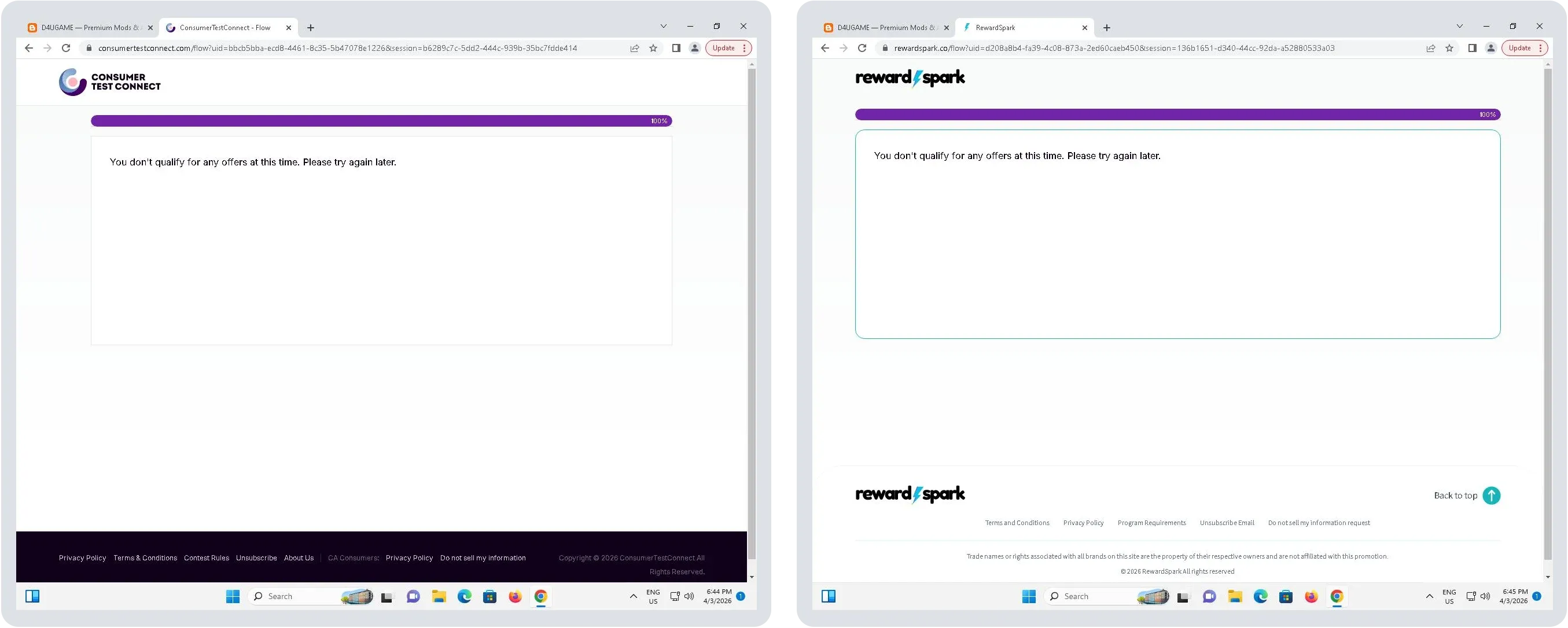
Researchers were unable to successfully complete surveys utilizing dummy information.
Figures 2.5.1 and 2.5.2, end of the surveys, saying users did not qualify.
With the surveys unsuccessful and other options not possible, researchers were unable to confirm the existence of the Spotify install, much less determine what it may be. Regardless of any payload delivery, it’s clear these techniques can be used to drive traffic to any site, which can easily be something dangerous.
It is clear attackers understand how to make successful content. Using social media is free and rewards frequent uploads. By using multiple platforms, accounts, and posts, attackers are able to access many users. Focusing their content into techniques that drive engagement only furthers their reach. Engagement can be encouraged through the nature of tutorials being saved and shared by users, or with techniques like asking for comments. Running a social media account is a very low time investment endeavor, and with AI voice and video generation, videos are becoming easier to mass produce. Social media provides ample opportunities for attackers to access victims, and it is likely there will be increasing numbers of these accounts and videos in the coming years.
The unfortunate thing is that these techniques work, with hundreds of thousands of views, thousands of saves, likes, and shares, and hundreds of comments. Comments, shares and saves are hugely influential on how well content performs, and these techniques leverage that priority. These videos clearly do reach a large audience.
In addition to being an effective way to spread malicious content, social media videos are hard to defend against, like any social engineering technique. Users who catch onto the malicious intent, either through research or falling for it themselves, may try to warn others in the comments. However, most platforms allow for creators to delete comments and block commenters, so diligent attackers can snuff out this resistance. Reporting videos is not a reliable way to get action taken either.
Researchers attempted to report posts on Instagram as scams, but the reports were rejected. Platform responses to reports are inconsistent, and even if a report gets to a human reviewer, said reviewer may not be qualified to understand the ramifications of these malicious videos. Even when a social media video or account is taken down, it is likely only after they have amassed a large amount of views, and threat actors can easily just start anew.
This kind of social engineering is an easy way for threat actors to drive traffic off social media and onto an attacker-controlled malicious website. Malware-as-a-service offerings make it extremely easy for people with any level of skill to profit off the exploitation of others, and the accessibility of social media makes the methodology detailed in this analysis a highly attractive way for threat actors to push malware.
There are likely many more variations of videos with the same intentions. People are looking for scams in their email inboxes and text messages, but not as much on their social media feed. Especially when these posts are under the guise of being helpful, rather than the urgency or sob stories associated with stereotypical phishing attempts. These videos can pop up at any time, so it is important that organizations stay prepared.
One of the key defenses against this kind of attack is to regularly audit permissions, ensuring people with installation privileges understand what they are installing. Most of these examples described in this analysis are leisure software, but they are not exclusively so. Some promise access to professional software, which employees may deem useful enough to attempt to use on work devices. Phishing training also needs to be maintained and up to date, so people are aware of the evolving threat landscapes.
Organizations must broaden their awareness of a variety of vectors, and focus on more than just typical avenues of phishing. Users are encouraged to report suspicious social media advice even when using personal social media on personal devices. The more reports, the more likely it is that the accounts are taken down, which does slow down the momentum of these attackers. Remaining diligent can help everyone be safer.
Short-form video platforms are being used by threat actors to encourage users to take risky actions. These actions may result in users downloading malicious content or giving up personal information to unsafe sources. Threat actors use tactics to increase the amount of engagement their posts get, spreading the harmful content across the website. This method is difficult to counter, since attackers can delete comments warning of the scams, and platforms are unlikely to intervene when content is reported. This leaves it on organizations to regularly audit permissions and train their staff to prevent these situations from occurring.
Hashes
03bbc4fa1fd784276da135ab62fef85aaddea66e6eb176d7e59c3398f818b153
Domains
Pluginchad[.]xyz
Maxapk[.]xyz
D4ug[.]site
Slmgr[.]sh
Ms[.] get
slmgr[.] sh
Accounts
tiktok[.]com/@windows.tips1
tiktok[.]com/@windows.insight
tiktok[.]com/@davidcooksey47
tiktok[.]com/@tracyhughe
tiktok[.]com/@mr.capcut.pro2
instagram[.]com/wtips404
instagram[.]com/wndwstips
instagram[.]com/epemberton369



![Spectra Analyze results for the executable from the msget[.]run domain.](/_next/image?url=%2Fapi%2Fmedia%2Ffile%2Fblog-researchers-notebook-tiktok-figure-15-2072x1222.webp&w=3840&q=75)

![D4ug[.]site, which claims to “Unlock premium games & AI tools”. Some examples of the offerings are Spotify Premium, CapCut Pro, and YouTube Premium.](/_next/image?url=%2Fapi%2Fmedia%2Ffile%2Fblog-researchers-notebook-tiktok-figure-23-1326x1092.webp&w=3840&q=75)
New btree malware bypasses the install script, negating the popular repo's measure barely two months after adoption.
This post-mortem on recent supply chain attacks and threat actors including S1ngularity, Shai-Hulud and TeamPCP can help you prepare for what comes next.
The package poses as a security tool targeting developers looking to implement Internet-based apps with telecom networks.