Spectra Assure Free Trial
Get your 14-day free trial of Spectra Assure for Software Supply Chain Security
Get Free TrialMore about Spectra Assure Free TrialAt a high level, development teams should model their response around the attacker's known priorities, which are to maximize the number of compromised organizations, harvest cloud secrets and access tokens, and exfiltrate intellectual property, including application source code.
A secondary outcome of lower probability is disruption, such as through the deployment of ransomware.
Here are steps to take to address the immediate risks of credentials misuse and IP theft:
Beyond the steps to address the immediate risk of compromise, development organizations should adopt practices and measures that will prevent similar attacks in the future. Those include:
A conventional SBOM tells you what components are present. An xBOM goes further, capturing relationships between components, cloud service dependencies, cryptographic assets, and ML models, all mapped across the full software development lifecycle.
In the context of the axios compromise, this additional insight matters because an SaaSBOM and CBOM would, after a supply chain compromise, sharply reduce your time to:
An xBOM provides additional information on each component and dependency — including relationships between different parts of an application and known vulnerabilities. When responding to the axios incident, practitioners with an xBOM don’t have to ask which packages they have and can focus instead on questions like which cloud services those packages were calling and what cryptographic material was accessible to them They can more precisely and quickly detect, scope, and respond to the incident.
For a full breakdown of what xBOM covers and how it maps to CycloneDX and SPDX export formats, see the ReversingLabs xBOM documentation. For context on why the industry is moving toward xBOM as a baseline requirement, see the RL blog post “Rise of the xBOM: The new go-to tool for software security.”
RL’s Spectra Assure provides complex binary analysis that enables software buyers to analyze third-party software without the need for source code — giving security teams a comprehensive view of what was present in software at a given point in time. And including binary analysis in the onboarding process enables organizations to have broader visibility across their software portfolio. That capability is critical for scoping exposure after a supply chain compromise and can improve incident-response effectiveness.
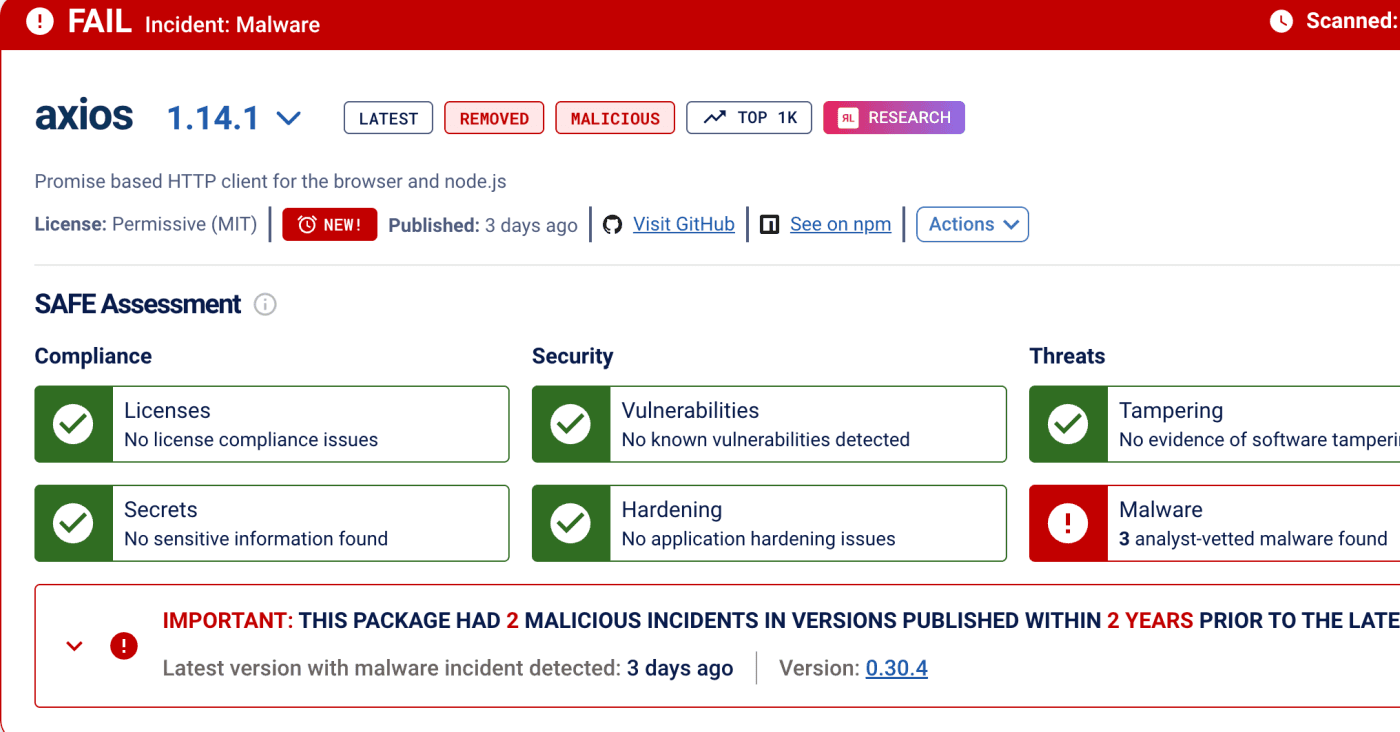
RL also hosts the Spectra Assure Community, a free platform where developers, DevOps engineers, and security practitioners can check the security status of open-source packages and developer tools. For the axios compromise specifically, practitioners can use it to check for affected package versions, identify whether their builds pulled in a compromised version, and verify the integrity of other npm dependencies in their pipeline.
The contents of software package and developer tool repositories are continually analyzed by RL, with the latest findings immediately available on the Spectra Assure Community website. And with a free Community API token, teams can automate checks on OSS dependencies and secure their pipeline at every stage of software development.
To automate the checks in a CI/CD pipeline, we recommend using RL-Protect or the RL-Protect GitHub Action, which detect compromised packages to prevent them from being incorporated into your builds.
Get started at docs.secure.software/community, or go directly to the Spectra Assure Community. For CI/CD integration details, see the rl-protect documentation.

Source scanners, SBOMs, certificate managers and questionnaires all answer a different question — and none of them inspects the software that shipped.
Post-quantum readiness depends on knowing where cryptography lives in the software you run, and a list of components can't tell you that.
With the EU Cyber Resilience Act’s Article 14 reporting requirements now live, executives need evidence drawn from the final software artifact.
-1400x732.jpg&w=3840&q=75)