Spectra Assure Free Trial
Get your 14-day free trial of Spectra Assure for Software Supply Chain Security
Get Free TrialMore about Spectra Assure Free TrialThis post was first published as an interim analysis on October 31, 2026, when the most important fact about the Binance theft was missing: how the attacker got in. On November 3, Binance published its initial findings, and the FBI has since attributed the theft to North Korea’s TraderTraitor. This update folds both in.
Binance’s account runs from a tampered Homebrew install in June, through a fake job interview in September that trojanized pyenv on an engineer’s Mac, to lateral movement through an internal AI tool on October 20 and a container that reached the wallet signing service on October 29. Roughly $6.34 billion left Binance hot wallets in under four hours. What is still missing is the material defenders hunt with: Binance named no malware family and published no file hashes, domains or IP addresses for the endpoint stages.
ReversingLabs (RL) adds two things. First, a check of what RL data can and cannot confirm about the stages Binance disclosed. Second, an RL view of a separate 2026 toolset, a trojanized Terraform provider delivering the FLATROOF and ROOFDECK backdoors, that Zscaler and SentinelOne attribute to TraderTraitor and that uses the same interview-assignment lure. No source links it to Binance. We will update this post again when Binance’s third-party review or technical indicators are published.
Binance published “29 October Binance Security Incident: Initial Findings and Response Update” on November 3, 2026. As Binance describes it, three engineers were compromised over five months:
Binance disclosed the file operations that replaced pyenv on Engineer B’s Mac:
Step | Operation | Path | Effect |
|---|---|---|---|
1 | Create | /opt/homebrew/Cellar/pyenv/2.8.0/libexec/pyenv_ | Staging file next to the real pyenv |
2 | Modify | libexec/pyenv_ | 3,414 bytes of malicious content written |
3 | Delete | libexec/pyenv | Legitimate pyenv (3,344 bytes) removed |
4 |
/opt/homebrew is writable by the logged-in user, so none of this needed a password prompt. Binance says it has rebuilt the wallet system and the internal AI tool, replaced devices, decommissioned credentials and tokens, scanned all employee devices and engaged independent security firms. It also reported 57 other suspected North Korea-linked attempts against it in 2026. SafeDep assesses that the interview phase matches the Contagious Interview pattern. Binance does not name a campaign.
The disclosed chain maps to ATT&CK as follows. IDs marked “likely” are our mapping where Binance does not describe the mechanism.
Stage (per Binance) | What happened | ATT&CK |
|---|---|---|
June, Engineer A | Search for an AI coding tool leads to a tampered Homebrew install; role and colleagues exposed | T1189 / T1583.008 (likely, malvertising), T1204.002, T1591.004 |
September, Engineer B | Fake “Project Director,” HR and CEO personas on a job platform and a chat app | T1566.003, T1585 |
September, Engineer B | Assignment repository setup replaces pyenv, obfuscates, contacts C2, removes traces | T1204.002, T1059.004, T1554 (T1574), T1027, T1070.004, T1071 |
October 20 | Internal AI tool used to take control of Engineers A and C; deployment token found on A’s machine | T1072 / T1021 (likely), T1552.001, T1528 |
How firm this is. The chain and the pyenv file operations come from Binance’s own report. X blocks automated retrieval, so we read it through a GitHub mirror and through SafeDep, crypto.news, Security Affairs and Fortune coverage, which agree on the details: high confidence. The identification of the June lure as SANS ISC 32942 rests on a single reading of the diary Binance links: low to medium confidence. No FBI, CISA or OFAC technical advisory has been published.
The FBI. On October 31, 2026, the FBI, the U.S. Secret Service and IRS Criminal Investigation attributed the theft to North Korea’s TraderTraitor. The alert consists of the attribution and a blocklist of addresses used for laundering; it does not describe initial access, malware or network infrastructure. North Korea has denied involvement.
Signing-path mechanics. TRM Labs, Elliptic and Cointegrity describe the EIP-7702 step consistently with Binance’s account; RL has not verified the on-chain data. One Ethereum transaction carried 50 EIP-7702 authorizations for the Binance14 hot wallet, one per consecutive nonce, so that whichever matched the wallet’s live nonce would delegate it to an attacker contract, and a single call then swept the wallet. Before Binance’s disclosure, we assessed that the attacker controlled the path that requests signatures rather than the keys. Binance has since confirmed that: a container deployed with a stolen token reached the signing service.
Attribution. The FBI attribution is the strongest statement available. The blockchain intelligence firms reached the same conclusion first, on their own evidence:
Source | Date | What it says | Basis given |
|---|---|---|---|
Oct 31, 2026 | TraderTraitor (North Korea) | Government attribution; address blocklist only; no technical intrusion detail | |
Oct 30, 2026 | TraderTraitor, high confidence | On-chain and off-chain intelligence; Tornado Cash-funded operator wallet, staging and rehearsal, pre-obtained signatures fired in one burst, matching Bybit (2025) and KelpDAO (2026) | |
Chainalysis, via The Hacker News and Forbes |
TraderTraitor, also tracked as Jade Sleet, UNC4899, Slow Pisces and Pressure Chollima, is a financially motivated North Korean cluster within the Lazarus umbrella. The FBI attributed the May 2024 DMM Bitcoin theft and the February 2025 Bybit theft to it. In both, a lure aimed at an engineer led to malware on that engineer’s machine and then to abuse of the victim’s own approval process. Binance’s account follows the same arc. SafeDep’s Contagious Interview assessment is compatible with the FBI attribution, but most vendors track Contagious Interview as a separate North Korean cluster, so the two are not the same claim.
As of November 4, 2026, none of the following has been published:
The Homebrew stage. RL classifies the samples from the diary Binance cites as follows: the fake page’s copy-and-paste script is suspicious MacOS.Trojan.Generic (4 of 24 scanners), the stage-1 zsh script is malicious MacOS.Trojan.MacSyncStealer (14 of 23), and the stage-2 script is suspicious MacOS.Infostealer.Generic (20 of 36). The command-and-control domain is flagged by 8 of 49 vendors. RL’s crawler fetched the fake Homebrew page repeatedly between April 28 and May 6, 2026. Binance places Engineer A’s install in June, a month after RL’s last capture of that page, so either the campaign was still running in June or Engineer A met a different one. RL submitted the diary’s URLs and two related domains reported by Moonlock for URL Analysis on November 4, 2026; none returned a file, so the payload hosts appear to be offline. RL holds more than 500 MacSync-named samples from April to November 2026: this is commodity macOS infostealer malvertising. RL data cannot confirm that the June install was this campaign.
The pyenv implant. Binance published sizes and paths but no hash. RL indexes legitimate pyenv scripts (its Docker Hub crawler holds 3,341- and 3,408-byte versions, both known), but RL found no pyenv file of 3,414 bytes and none classified malicious or suspicious. Cannot confirm from RL data. Hunting for it today means hunting for the behavior: a libexec/pyenv in Homebrew’s pyenv 2.8.0 that is not 3,344 bytes, a pyenv_ staging file, or pyenv opening outbound network connections. The Sigma rule below covers the staging file.
Binance’s disclosed implant was a trojanized pyenv, not the trojanized Terraform provider described here, and no source links this toolset to Binance. We include it because it is the best-documented 2026 toolset attributed to TraderTraitor (Zscaler gives medium confidence) that uses the same kind of lure: a fake interview, then an assignment repository that runs code on a developer’s Mac. Microsoft reported on October 29 that Jade Sleet, its name for TraderTraitor, ran three front companies in one week of June 2026, including a spoofed “AI-powered blockchain intelligence company.” That is the same front-company tradecraft; no source ties those companies to Binance’s interviewers.
Zscaler ThreatLabz (October 8) and SentinelOne LABS (September 18) documented the toolset. In SentinelOne’s case, a DevOps engineer at an Indian IT firm ran terraform init on an interview project whose .terraform.lock.hcl pointed at a lookalike registry; the implants were on disk by March 18, 2026.
RL researchers looked up every published indicator in Spectra Intelligence, ran RHA similarity pivots, and queried the RL data warehouse. Classifications and scanner counts come from the Spectra Intelligence File Reputation API (TCA-0101); the figures show Spectra Analyze’s “community threat detections” count, which runs one or two lower.
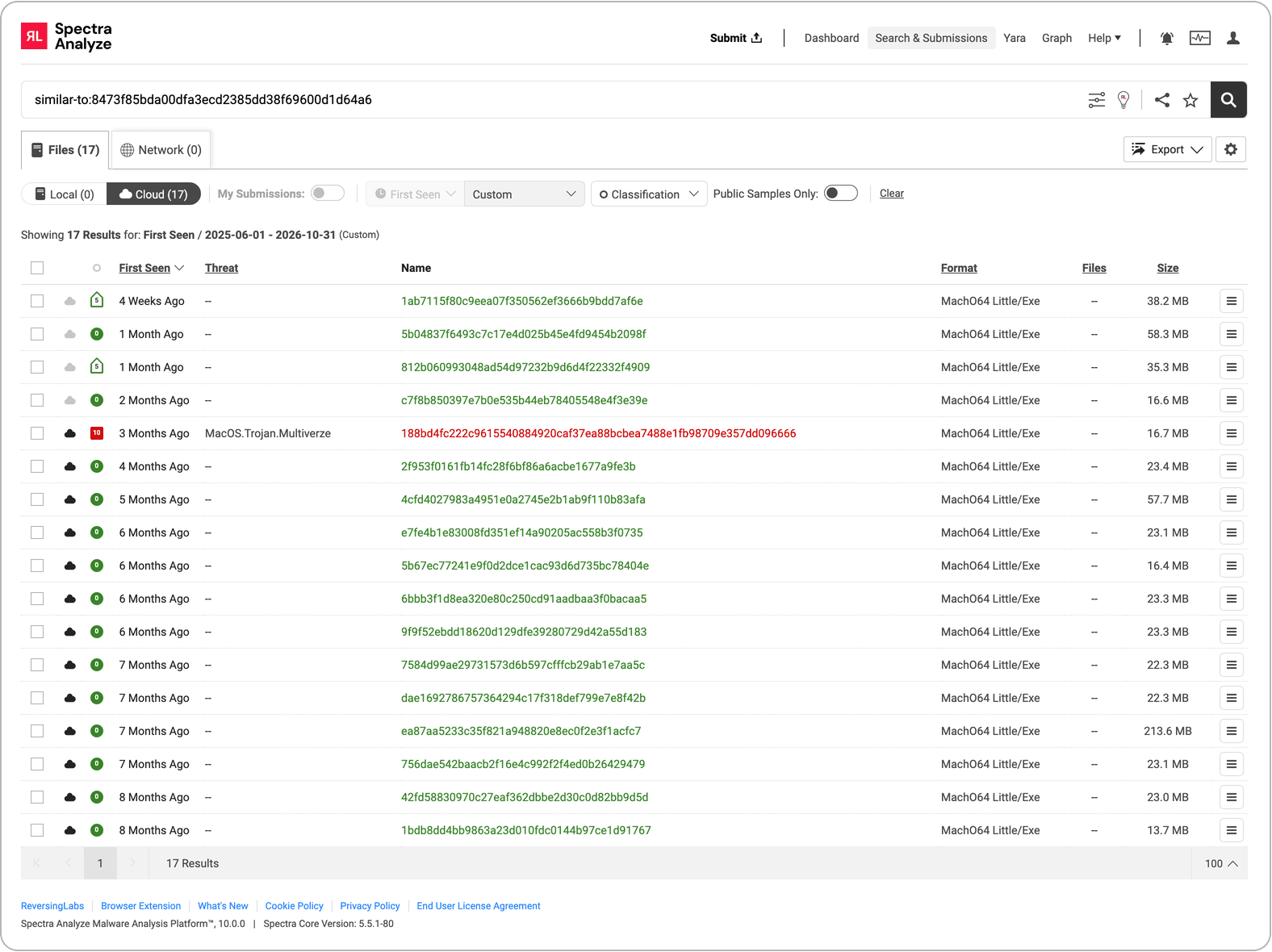
RL first saw terraform-provider-awsbeta_v1.0.0 (SHA-1 8473f85bda00dfa3...) on July 23, 2026, 77 days before the public write-up. It is malicious, threat name MacOS.Trojan.Multiverze, a 17.5 MB Go Mach-O flagged by 7 of 24 scanners. RHA, RL’s functional similarity hash, clusters it with 16 goodware Terraform AWS provider builds: it is the real provider with a small malicious package compiled in, so structure-based allow-listing will wave it through. Per Zscaler, it writes a run-once marker (session.lock), fetches a Bash script from diagnose[.]hashicorp-terraform[.]io, saves it as safari_updater, runs it detached, and then works as a normal provider.
Figure 1. RHA similarity results for the trojanized provider in Spectra Analyze. Note that one malicious sample sits among 16 goodware provider builds; similarity alone cannot separate them.
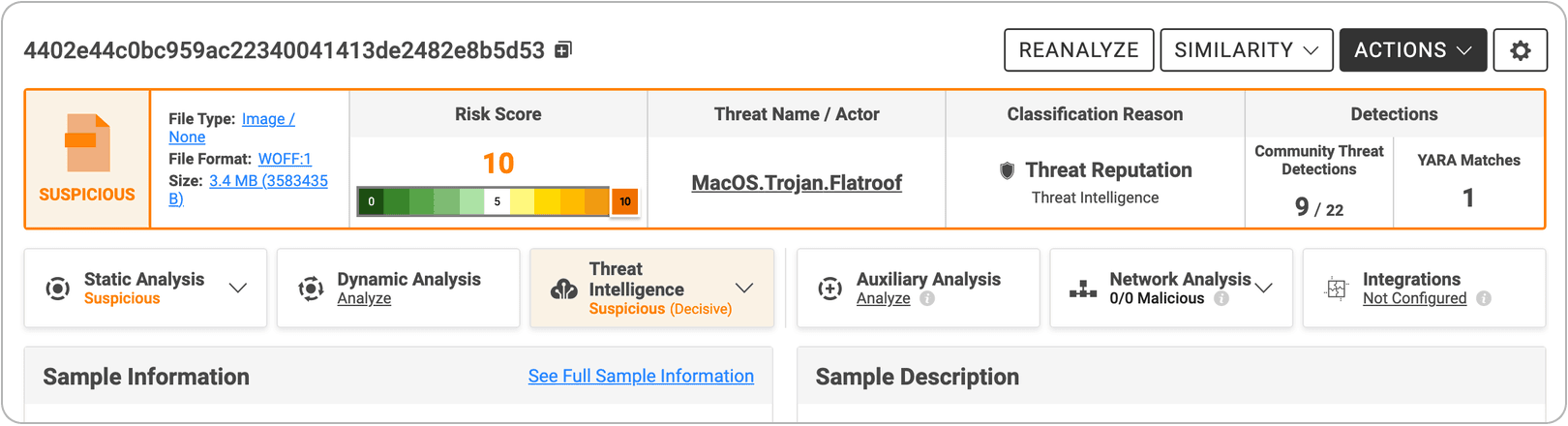
safari_updater (SHA-1 d81081691c3631f3...) arrived twelve minutes later. The 5.6 KB shell script is suspicious, MacOS.Trojan.Generic, 11 of 24 scanners. It downloads a per-platform payload disguised as a font: decoy WOFF data, an @@ENDFONT@@ marker, then a Base64-encoded, AES-256-CBC-encrypted executable. Of Zscaler’s eight container hashes, RL holds one, the macOS ARM64 HiraginoSans-Regular.woff (SHA-1 4402e44c0bc959ac...), suspicious under the family name MacOS.Trojan.Flatroof.
Figure 2. Spectra Analyze record for the FLATROOF font container. Note the WOFF file type and the suspicious classification despite the file presenting as a font.
RL read the loader directly. It tries supportaru[.]serveftp[.]com first, written with a doubled https://https:// scheme so it always fails, then a GitHub mirror under the bluearuhost account, then a Vercel site. It decrypts with OpenSSL (legacy MD5 key derivation) and a hardcoded passphrase, PTa3WZPQZAjj55t@, strips the quarantine attribute, ad-hoc signs the payload and launches it with --type=renderer so it passes for a Chromium renderer. We decrypted the RL-held container in an isolated environment without executing the output. The result is a 2.3 MB arm64 Rust Mach-O that Spectra Intelligence already held as malicious MacOS.Trojan.Gaslight (SHA-256 3c254614de8c1a2f..., 10 of 24 scanners, first seen July 23, 2026).
SentinelOne’s name for FLATROOF is “macOS.Gaslight.” RL holds five more MacOS.Trojan.Gaslight samples that appear in no public report, first seen between June 24 and October 11, 2026; one is an RHA sibling of the decrypted payload. Scanner coverage falls from 11 of 24 on the June build to 7 of 38 on the October builds. We assess these are likely FLATROOF builds; we have not reverse engineered them.
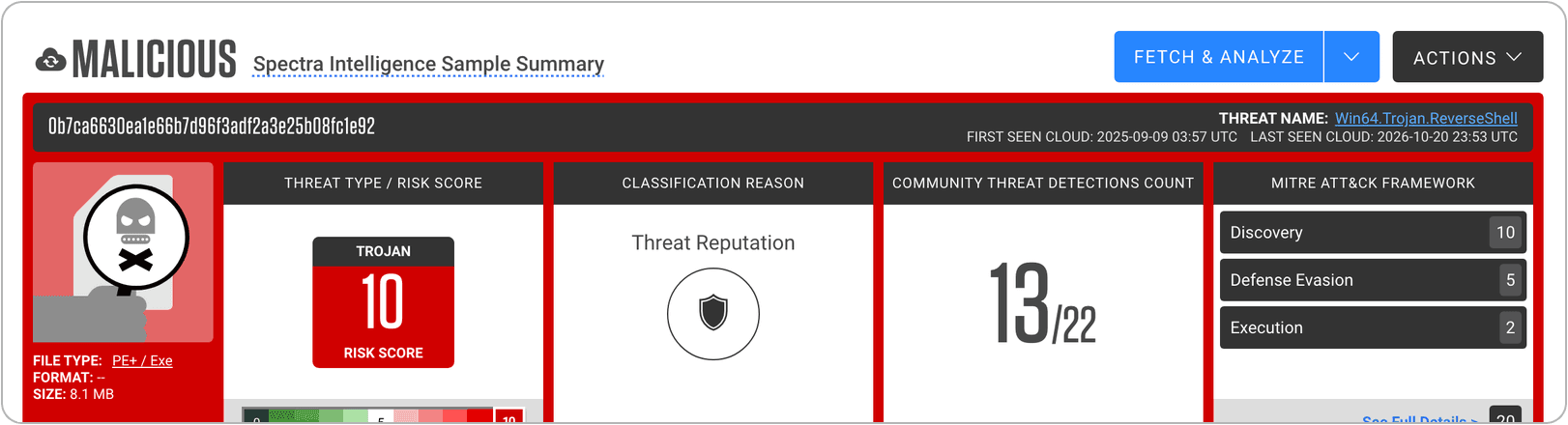
FLATROOF runs Python credential stealers and installs a second backdoor, ROOFDECK. RL holds:
Figure 3. Spectra Intelligence summary for Windows ROOFDECK. Note FIRST SEEN CLOUD 2025-09-09 03:57 UTC and the generic threat name Win64.Trojan.ReverseShell.
Per SentinelOne, ROOFDECK reads its server address from the website field of a Nostr profile, with Pastebin as a fallback, and accepts only RSA-signed commands over HTTPS with a pinned certificate. RL’s names across the toolset are Multiverze, Flatroof, Gaslight, GetShell and ReverseShell. None says TraderTraitor, and RL holds no TraderTraitor-named sample first seen between June 2025 and October 2026, so searching telemetry for actor labels will miss this toolset.
HivePro’s advisory lists 11 hashes. RL holds all 11, all malicious and all four to six years old: AppleJeus-era trading-app trojans named Win32.Trojan.Tradertraitor, Win64.Trojan.Tradertraitor and MacOS.Trojan.TraderTraitor (RL’s casing differs by platform), plus NukeSped variants. They are real TraderTraitor indicators but not this campaign. Of the HivePro domains, only technicais[.]sytes[.]net served malware in RL data; review the rest before blocking.
Indicator | Role | Vendors flagging |
|---|---|---|
diagnose[.]hashicorp-terraform[.]io | Bash loader download | 5/48 |
registry[.]hashicorp-terraform[.]io | Lookalike registry | 0/49 |
registry[.]hashicorp-aws[.]com | Lookalike registry | 2/50 |
supportaru[.]serveftp[.]com | FLATROOF payload host | 2/49 |
arusupport-region1-webhook[.]online |
Vendor detection is thin, so a lock file that pins providers to a non-HashiCorp registry is a better signal than any reputation score. RL’s URL records first saw the FLATROOF webhook host on July 25, 2026, 75 days before the Zscaler publication. Pivots on grenight[.]com and glowmedaesthetics[.]com are noisy: RL holds hundreds of goodware feed and blocklist files that contain them.
The chain below is the Terraform toolset, not the Binance intrusion. It combines Zscaler’s and SentinelOne’s analysis with the samples RL holds. Stages marked [RL] are present in RL’s repository.
fake interview repo  (.terraform.lock.hcl -> registry[.]hashicorp-terraform[.]io)
└── terraform init
    └── terraform-provider-awsbeta_v1.0.0          [RL] malicious, MacOS.Trojan.Multiverze
        ├── writes session.lock                     (run-once marker)
        └── sh -c ./safari_updater &                [RL] suspicious, MacOS.Trojan.Generic
            ├── curl <font>.woff from supportaru[.]serveftp[.]com | GitHub | Vercel
            │                                       [RL] 1 of 8 containers, MacOS.Trojan.Flatroof
            ├── split at @@ENDFONT@@ -> base64 -d -> AES-256-CBC decrypt (openssl -md md5)
            ├── xattr -d com.apple.quarantine; codesign -s - (macOS)
            └── ~/Library/com.apple.iTunesCloud/SystemUpdate --type=renderer   (FLATROOF, Rust)
                │                                   [RL] malicious, MacOS.Trojan.Gaslight (decrypted by RL)
                ├── persistence: ~/.zlogout hook (macOS) | snap-imagent service (Linux)
                │                | HKCU Run "powershell-config-service" (Windows)
                ├── Python stealers: browser cookies, logins, keychain, shell history
                │   -> collected_data.zip
                ├── C2: Telegram bot | GitHub API | hxxps://arusupport-region1-webhook[.]online
                └── ROOFDECK (imagent / update.exe)  [RL] malicious, GetShell / ReverseShell
                    └── C2 resolved via Nostr profile -> Pastebin (RSA-signed) -> delay[.]servehttp[.]com
From an engineer’s workstation, stolen browser sessions, cloud credentials and shell history give an operator authenticated access to internal systems without defeating MFA, which is how TraderTraitor operated in the DMM Bitcoin and Bybit cases, per the FBI. Binance’s account follows the same arc with a different implant: a trojanized pyenv on one engineer’s Mac, then control of two more engineers’ machines through an internal AI tool, a stolen container-deployment token and a container that reached the signing service.
All IOCs and indicators in this blog post can be found in our GitHub repository [LINK]. The following is a subset for reference. Binance has published host artifacts for the pyenv implant but no hashes, domains or IP addresses. The file indicators below are the Terraform toolset as present in RL, the FLATROOF builds RL holds, and the Homebrew-stage samples from the diary Binance cites. None of them is a confirmed Binance IOC.
Host artifacts (published by Binance unless noted; macOS, owned by the logged-in user):
Artifact | Type | Description |
|---|---|---|
/opt/homebrew/Cellar/pyenv/2.8.0/libexec/pyenv_ | File | Staging file; 3,414 bytes of malicious content |
/opt/homebrew/Cellar/pyenv/2.8.0/libexec/pyenv | File | Legitimate 3,344-byte file deleted and replaced by the renamed pyenv_ |
/opt/homebrew/bin/pyenv | Symlink | Deleted and recreated, followed by a zsh spawn |
/tmp/osalogging.zip | File | MacSync staging archive (SANS ISC 32942; link to Binance unconfirmed) |
File indicators:
SHA-256 | SHA-1 | MD5 | Description |
|---|---|---|---|
188bd4fc222c9615540884920caf37ea88bcbea7488e1fb98709e357dd096666 | 8473f85bda00dfa3ecd2385dd38f69600d1d64a6 | 9d78ece09457907b730d139e4e0c64dd | terraform-provider-awsbeta_v1.0.0, trojanized provider, RL: MacOS.Trojan.Multiverze |
451b586ec9d3c997b319986a1177829653e8ae641c953c05ede6a38616f2da97 | d81081691c3631f3adc1a6db0ee22ab19682ef30 | 73adaea97f003735335505858c1c6def | safari_updater Bash loader, RL: MacOS.Trojan.Generic |
62e988e9affcd000657bef4db47eb2e85c9a4cc42f4832780a02e19624e36e38 | 4402e44c0bc959ac22340041413de2482e8b5d53 | be60c52ca8a01fef7dc15c2f0ebb77d8 |
Zscaler-published font containers not present in RL (MD5): 116f7189ed7b41f1b339a749d56e63be, 58fa0d651898446d5f5d2ed8a27a3330, 2621753691be9521288664bb551dfba6, ad0b1b6d2c8b9d09d6473a4a299470ab, 4b8509cde757b5428e5f99c8dffe73ca, 3826dc7a9ba8bd5b1c143560c1530d89, 34a52e6a4d803e94fe497bab682abfd3.
Network indicators (2026 toolset):
Indicator | Type | Description |
|---|---|---|
registry[.]hashicorp-terraform[.]io | Domain | Lookalike Terraform registry referenced by weaponized lock files |
registry[.]hashicorp-aws[.]com | Domain | Lookalike Terraform registry |
diagnose[.]hashicorp-terraform[.]io | Domain | safari_updater download host |
hxxps://diagnose[.]hashicorp-terraform[.]io/plugins/grpc/v6/schema/metrics/333afe63-c5a2-43f0-b046-7cbaa7797e8a | URL | Full URL on the loader download host, as published by Zscaler |
On-chain indicators. Wallet addresses are outside the scope of this post. The FBI alert lists the addresses tied to the theft.
The Source column distinguishes techniques from Binance’s disclosure (“Binance”), techniques Spectra Core mapped from RL samples or RL’s loader analysis (“RL”), and techniques described in third-party analysis of the Terraform toolset (“3P”). Mapped against ATT&CK Enterprise at the time of writing.
Technique | ID | Description | Source |
|---|---|---|---|
Drive-by Compromise / Acquire Infrastructure: Malvertising | T1189, T1583.008 | Search for an AI coding tool leads to a tampered Homebrew (likely mapping) | Binance (likely) |
Gather Victim Org Information: Identify Roles | T1591.004 | Engineer A’s role and wallet-infrastructure colleagues exposed | Binance |
Establish Accounts | T1585 | Fake “Project Director,” HR and CEO personas | Binance |
The EIP-7702 delegation abuse does not map cleanly to an existing ATT&CK technique. We describe it as protocol abuse following signing-path compromise. A Navigator layer JSON is available on request.
Binance published no hash for the pyenv implant, but it did publish the file operations, and those are specific. This rule looks for the staging file name next to the Homebrew pyenv executable.
title: Homebrew pyenv Executable Staged and Replaced via pyenv_ File
id: 9c3e5b7a-2f41-4d8e-b6a0-7e1c4d2f8a63
status: experimental
description: Detects creation of a pyenv_ staging file in the Homebrew pyenv libexec directory, the first step of the pyenv replacement Binance disclosed for its October 2026 intrusion
references:
    - https://www.reversinglabs.com/blog/[post-slug]
author: [RL researcher], ReversingLabs
date: 2026-11-04
tags:
    - attack.persistence
    - attack.t1554
    - attack.execution
    - attack.t1204.002
logsource:
    product: macos
    category: file_event
detection:
    selection:
        TargetFilename|endswith: '/libexec/pyenv_'
        TargetFilename|contains:
            - '/opt/homebrew/Cellar/pyenv/'
            - '/usr/local/Cellar/pyenv/'
    filter_brew:
        Image|endswith: '/brew'
    condition: selection and not filter_brew
falsepositives:
    - Manual pyenv patching by a developer (rare)
level: high
Legitimate brew upgrade and brew reinstall runs touch these paths but do not use a pyenv_ staging name. Where file-event telemetry is thin, correlate in your EDR instead: a rename onto libexec/pyenv by a process that is not brew, the /opt/homebrew/bin/pyenv symlink being deleted and recreated within seconds, and a zsh child spawned right after.
The font container is the most distinctive artifact in the chain: a valid WOFF header followed by a text marker and a long Base64 blob, which legitimate fonts do not contain. The loader has to reference the same marker to split the file, so we pair the two.
rule RL_TraderTraitor_FlatroofFontContainer_2026 {
    meta:
        description = "WOFF file carrying an appended @@ENDFONT@@ marker and Base64 payload, as used to stage FLATROOF"
        author      = "[RL researcher], ReversingLabs"
        date        = "2026-10-31"
        reference   = "https://www.reversinglabs.com/blog/[post-slug]"
        hash        = "62e988e9affcd000657bef4db47eb2e85c9a4cc42f4832780a02e19624e36e38"
        score       = 85
    strings:
        // Delimiter between decoy font data and the encrypted payload
        $marker = "@@ENDFONT@@" ascii
        // Base64 run that follows the marker (long, no whitespace)
        $b64 = /@@ENDFONT@@[A-Za-z0-9+\/]{512}/ ascii
    condition:
        uint32be(0) == 0x774F4646        // "wOFF"
        and filesize < 20MB
        and $marker and $b64
}

rule RL_TraderTraitor_FlatroofLoader_Script_2026 {
    meta:
        description = "Shell loader that splits a .woff file at the @@ENDFONT@@ marker to recover the FLATROOF payload"
        author      = "[RL researcher], ReversingLabs"
        date        = "2026-10-31"
        reference   = "https://www.reversinglabs.com/blog/[post-slug]"
        hash        = "451b586ec9d3c997b319986a1177829653e8ae641c953c05ede6a38616f2da97"
        score       = 75
    strings:
        $marker = "@@ENDFONT@@" ascii
        $woff   = ".woff" ascii
    condition:
        uint32be(0) != 0x774F4646 and filesize < 200KB
        and $marker and $woff
}
The loader’s decryption depends on the marker and the Base64 run after it, so a variant that changes them must also change the loader; the spoofable font names are not used. Test against a corpus of web fonts before production use. For more precision, require @@ENDFONT@@U2FsdGVkX1 (marker plus OpenSSL salt header), at the cost of missing variants that insert whitespace or change cipher.
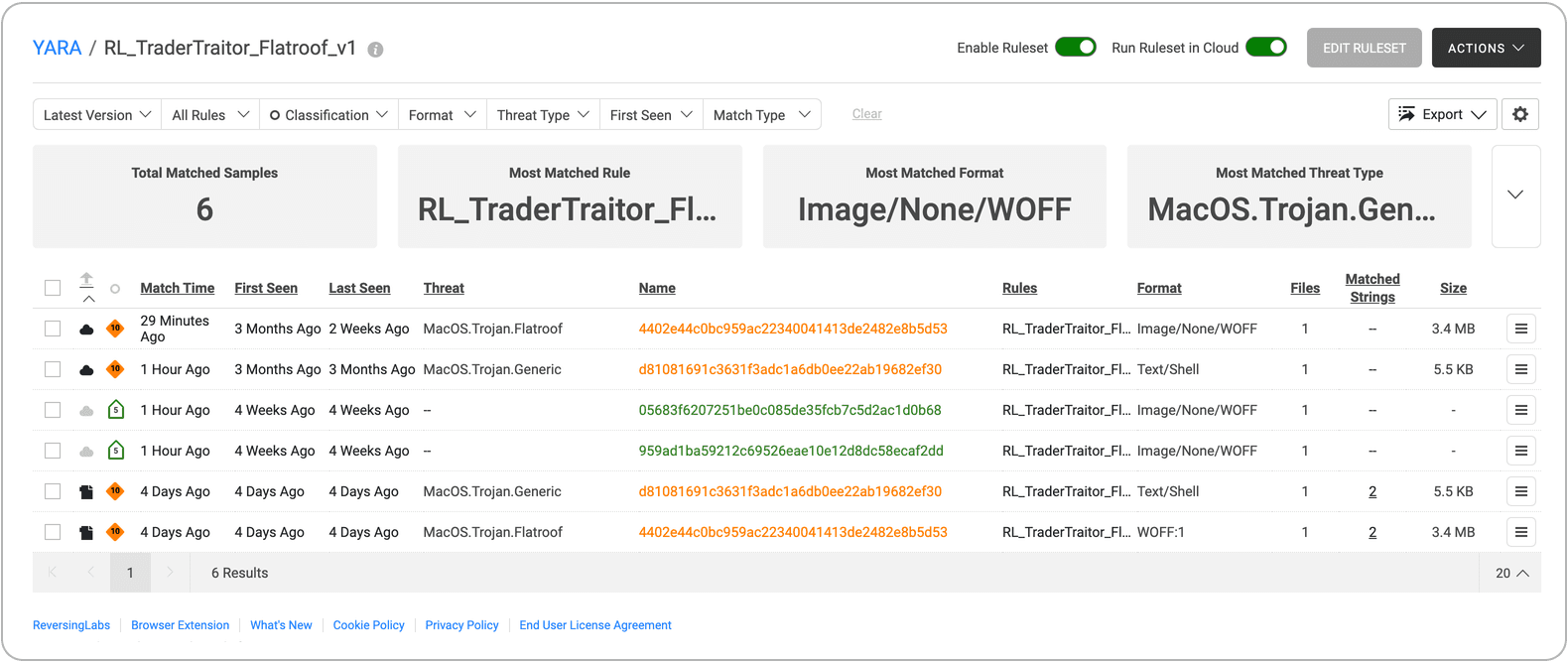
RL ran the ruleset as a Cloud Retro hunt twice. The October 31 run was cancelled after more than 70% progress. A second run started on November 4 at 16:55 UTC; at 72% progress (19:32 UTC) it had matched the same four files and nothing new. [EDITOR: update when the run completes, ETA 20:33 UTC.] Two are the positive controls: the container (suspicious, MacOS.Trojan.Flatroof) and the loader (suspicious, MacOS.Trojan.Generic). The other two are WOFF files that appear in no published IOC list:
SHA-256 | SHA-1 | MD5 | RL status (TCA-0101) |
|---|---|---|---|
76ec916464baf025c9573f78fc413f5eab0d03f4ada6cd247671f0f4ab4fbcae | 959ad1ba59212c69526eae10e12d8dc58ecaf2dd | 8d4caaa508cdb6f04fa670a339026f6c | goodware, 0 of 38 scanners, first seen 2026-10-09 |
1f96fc738fecc8e137244b5c3d0890ba2e618c57975478716bf20848eecda1e0 | 05683f6207251be0c085de35fcb7c5d2ac1d0b68 | 2d0ab2e7342f8face5b1558fddea1712 | goodware, 0 of 38 scanners, first seen 2026-10-09 |
RL classifies both as goodware, and no scanner flags either. They match because each carries the @@ENDFONT@@ marker followed by a long Base64 run, the structure of a FLATROOF container whose payload is encrypted at rest, so we treat them as possible containers. Both were first seen on October 9, the day after the Zscaler publication. They are private uploads that RL cannot download or decrypt, so they remain hunting leads, not IOCs.
Figure 6. Matches for the RL_TraderTraitor_Flatroof_v1 ruleset in Spectra Analyze. The cloud rows show the two positive controls (suspicious) and the two unpublished WOFF files (goodware). The bottom two rows are local re-matches of the positive controls after RL pulled them onto the appliance.
title: Terraform Provider Plugin Spawning Shell or Network Utility
id: 4f2a9c61-8b3e-4d7a-9e15-2c6d0b7f3a18
status: experimental
description: Detects a Terraform provider plugin process launching a shell, curl or decryption tooling, as seen with the trojanized terraform-provider-awsbeta used to deliver FLATROOF
references:
    - https://www.reversinglabs.com/blog/[post-slug]
author: [RL researcher], ReversingLabs
date: 2026-10-31
tags:
    - attack.execution
    - attack.t1059.004
    - attack.initial_access
    - attack.t1195.001
logsource:
    product: macos
    category: process_creation
detection:
    selection_parent:
        ParentImage|contains: '/terraform-provider-'
    selection_child:
        Image|endswith:
            - '/sh'
            - '/bash'
            - '/zsh'
            - '/curl'
            - '/openssl'
            - '/xattr'
            - '/codesign'
    condition: selection_parent and selection_child
falsepositives:
    - Community providers that legitimately shell out (rare; review and allow-list by provider name and signer)
level: high
Duplicate the rule with product: linux for Linux build hosts. On Windows, alert on a terraform-provider-*.exe parent spawning powershell.exe, cmd.exe or curl.exe.
Spectra Intelligence users can query every hash and domain in the IOC section for RL’s current classification and first-seen date, including the unpublished FLATROOF builds. Spectra Analyze can run the YARA rules against local repositories and RL’s cloud corpus, and re-run the RHA similarity searches that surfaced the ROOFDECK and FLATROOF siblings. Spectra Detect customers can deploy the YARA rules at ingestion.
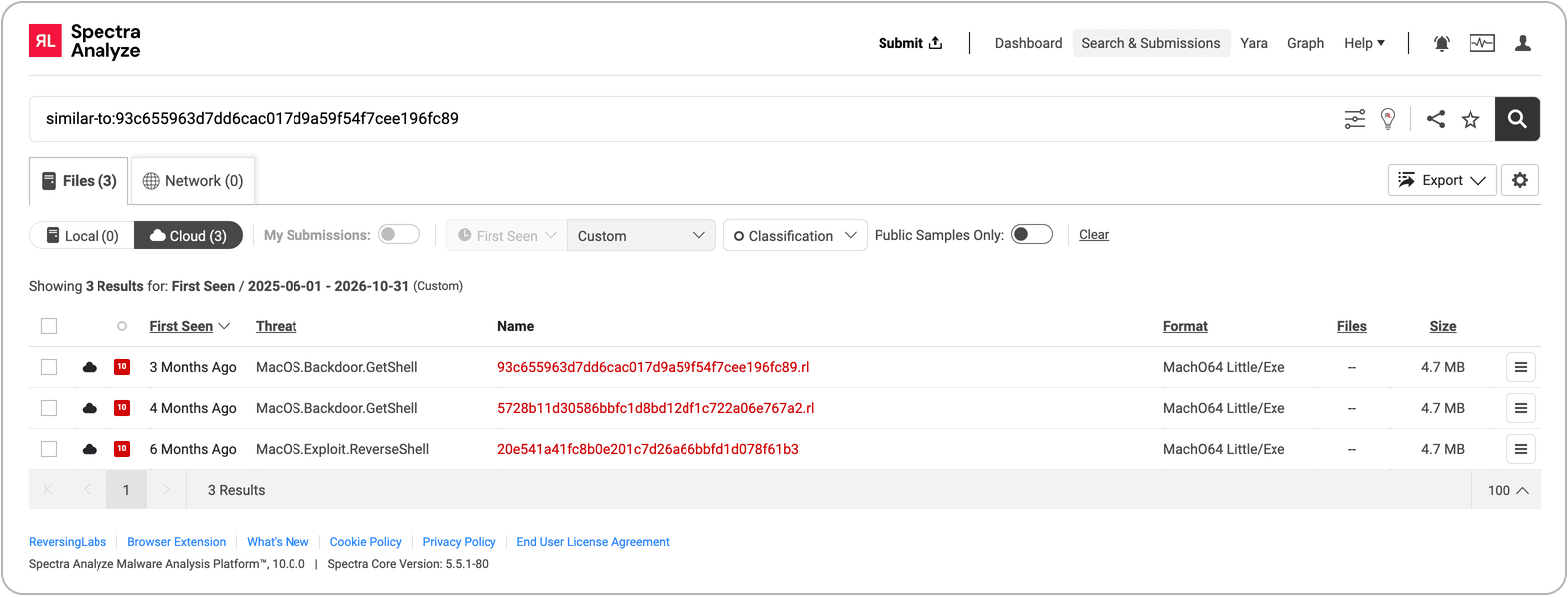
Figure 4. Spectra Analyze RHA similarity results for macOS ROOFDECK. Note the three 4.7 MB malicious Mach-O files: the published sample (MacOS.Backdoor.GetShell) and two earlier siblings (MacOS.Exploit.ReverseShell) first seen four and five months ago.
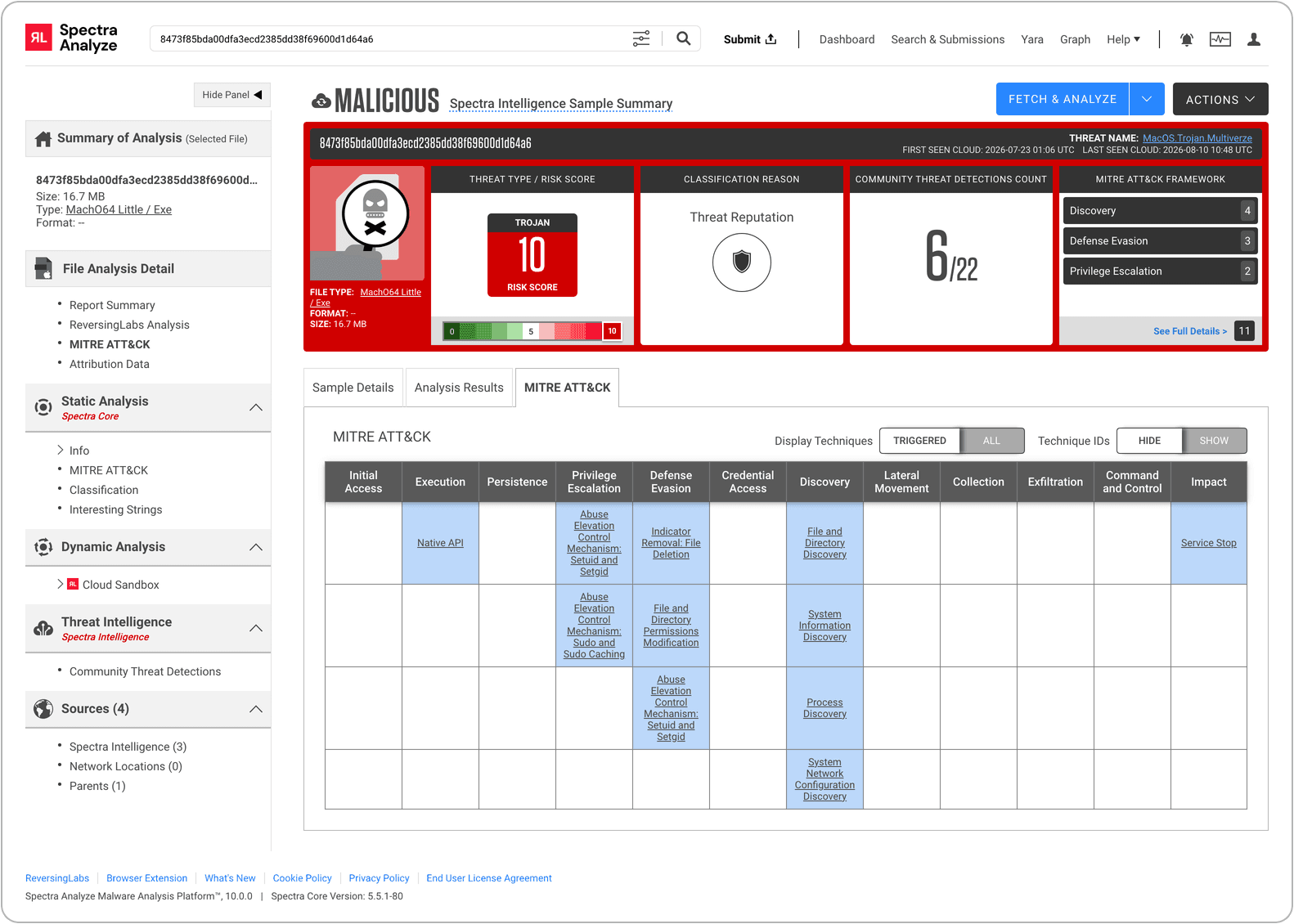
Figure 5. Spectra Core ATT&CK mapping for the trojanized Terraform provider. Note Sudo and Sudo Caching (T1548.003), Setuid and Setgid (T1548.001) and File Deletion (T1070.004) alongside the discovery techniques.
The Binance theft is the largest crypto heist on record, and its intrusion chain is now public in outline: a fake interview, a trojanized developer tool that endpoint security missed, an internal AI tool, a token on a laptop and a signing service that accepted what a container asked it to sign. The FBI attributes it to TraderTraitor. Defenders still lack the implant’s hashes and infrastructure, and RL data cannot fill that gap: RL holds no sample of the pyenv implant. What RL adds is context. The Homebrew stage Binance points to resembles commodity MacSync malvertising. The Terraform toolset that Zscaler and SentinelOne documented is a separate case with the same kind of lure, and parts of it have circulated since autumn 2025. On current evidence the pyenv implant and the Terraform toolset are different implants delivered by the same kind of lure; whether the same operators run both cannot be confirmed from RL data. Hunting for the delivery pattern, interview code that runs on install or build and tampering inside package-manager directories, will catch more of this activity than any single hash list.
We will update this post when Binance’s third-party review or technical indicators are published, and as RL analysis continues.
As the malware ecosystem evolves, RL will continue to monitor, decode, and report on these changes, helping organizations spot threats before they escalate.

Rename
pyenv_ to pyenv |
Malicious copy put in place |
5 | Delete | /opt/homebrew/bin/pyenv | PATH entry removed |
6 | Link | /opt/homebrew/bin/pyenv | Recreated as a symlink, then zsh spawned |
October 29 | Logon to C’s machine, A’s credentials, container deployed, script reaches the signing service | T1610, T1078, T1059 |
October 29-30 | About 50 signings set EIP-7702 delegations; funds leave hot wallets | T1565.002 (closest fit), T1657 |
Oct 30, 2026 |
“A high degree of confidence that DPRK is responsible”; CEO Jonathan Levin names TraderTraitor as likely |
Binance proceeds commingled with funds from the September 2026 Bitget exploit |
Oct 30-31, 2026 | TraderTraitor “likely,” not certain | Laundering alongside Bitget proceeds; shared services with TraderTraitor thefts of BigONE, WOO X and AFX; Bybit-like staff targeting and signing abuse. Cautions: small overlap, slower laundering than usual |
Secondary reporting: TechCrunch, Euronews, Hackread, Cointegrity | Oct 30, 2026 | Report the TRM and Elliptic attributions; Cointegrity calls TraderTraitor “probable, not confirmed” | Independent review of the above; the shared Bitget/Binance address holds about $39,000 of Binance-linked funds |
FLATROOF C2
4/48 |
delay[.]servehttp[.]com | ROOFDECK C2 | 3/49 |
hxxps://pastebin[.]com/raw/3yptBDhL | ROOFDECK dead drop | 0/49 |
registry[.]hashicorp-aws[.]io | Lookalike registry (SentinelOne) | 2/49 |
storage[.]hubpage[.]cloud | Toolset infrastructure (SentinelOne) | 3/48 |
grenight[.]com | Toolset infrastructure (SentinelOne) | 4/49 |
HiraginoSans-Regular.woff, encrypted FLATROOF (macOS ARM64), RL: MacOS.Trojan.Flatroof
3c254614de8c1a2f213c526b0e5072d43ffeb7cc340d9a4a6ebaa16592b3bbe0 | 13888e384b2747758aca2e42dee7dc63393b9f57 | dfa191ca6817ec56e6986e728b323f92 | Decrypted FLATROOF (macOS ARM64), Rust Mach-O installed as SystemUpdate; recovered by RL from the container above, RL first seen 2026-07-23, RL: MacOS.Trojan.Gaslight |
4ba58fba8e1293e1d980726323bda0fcd3cc1e5781a99e86638a4a7641b6ffd6 | 93c655963d7dd6cac017d9a59f54f7cee196fc89 | 2b81aceab0142472d94eb42e500b27b1 | imagent, macOS ROOFDECK, RL: MacOS.Backdoor.GetShell |
e1c71374814e5d907afb913108090b8abf21ae2131c0880f013a3b9108a9d0fc | 0b7ca6630ea1e66b7d96f3adf2a3e25b08fc1e92 | 9d88b4494c7bc27b10358b68a899ad54 | update.exe, Windows ROOFDECK, RL first seen 2025-09-09, RL: Win64.Trojan.ReverseShell |
61a110681a70af3dc21634558e12b1c00964f0cf48e90c89896eb0fda1e60b2d | 20e541a41fc8b0e201c7d26a66bbfd1d078f61b3 | c22a69c45ec74af11a9f87f195ebd392 | macOS RHA sibling of ROOFDECK, RL first seen 2026-05-22, RL: MacOS.Exploit.ReverseShell (new, RL) |
f3404ef308098202246f2f3c38c8c3166e9a8e7843ec69c1b11ac0ce9cb4038e | 5728b11d30586bbfc1d8bd12df1c722a06e767a2 | c43f594fac7544e5485cbbe441e470bf | Stripped ROOFDECK loginwindow (published by SentinelOne), RL first seen 2026-07-13, RL: MacOS.Exploit.ReverseShell |
77b4fd46994992f0e57302cfe76ed23c0d90101381d2b89fc2ddf5c4536e77ca | c491d477dbe0ae04e9aed9dbe237144c03f73ec4 | d95dede4387ff516f4c23351c450427d | ROOFDECK iSync (published by SentinelOne), RL first seen 2025-10-03, downloaded from technicais[.]sytes[.]net, RL: MacOS.Backdoor.GetShell |
6328567511d88fdc2ae0939c5ef17b7a63d2a833881900de018a4f12f4982525 | 1948f50831621e1a016a3bf3b068e3897ec70866 | c586e6be49105a23af8f306b560e35e6 | Likely FLATROOF build, RL first seen 2026-06-24, RL: MacOS.Trojan.Gaslight (new, RL) |
41adffbceec976d0b485d72f81427d20a8781c383744e659b68cdd7acaaf9f05 | 7bf5bd537e56d1622a2062c8230dae4a2b0c9a6d | 0864185c7ed85627cd755f41ffa91656 | Likely FLATROOF build, RL first seen 2026-08-07, RL: MacOS.Trojan.Gaslight (new, RL) |
82cf467cf31f152e1a2e03b1774dd863edc02772b4f41960425e836c4d441354 | 119bcd39e28dee20ad6762c4d640a8c586cfe23e | 47e5d544dffbd92f771377f4ee8f8428 | Likely FLATROOF build, RL first seen 2026-10-09, RL: MacOS.Trojan.Gaslight (new, RL) |
f302bbd20c9b6f805f139b76f7514ac9817c62903722eb926b8d8d33dd724077 | 1798c89acb758ed69e03a08d05d3790dfece00d3 | 643e0c68cb56e0b794204a07112149ed | Likely FLATROOF build, RHA sibling of the decrypted payload, RL first seen 2026-10-09, RL: MacOS.Trojan.Gaslight (new, RL) |
ad9531866c82780b32c7b2cbdd28a7e39422d2101e83791be86e4fc011379a43 | de43b28a9a3c85a429f81aed07c0e13c4112800b | 3da00848071e2f17c84b357fd34b5814 | Likely FLATROOF build, RL first seen 2026-10-11, RL: MacOS.Trojan.Gaslight (new, RL) |
a4fcfecc5ac8fa57614b23928a0e9b7aa4f4a3b2b3a8c1772487b46277125571 | 1673401324d634aeb6dbeba4c8c59cb80e9b1ebb | 6fc64b5c620f9784bdd4e06c527f6aca | Fake Homebrew copy-and-paste script (SANS ISC 32942; cited by Binance, campaign link unconfirmed), RL: MacOS.Trojan.Generic |
0d58616c750fc8530a7e90eee18398ddedd08cc0f4908c863ab650673b9819dd | 0ab92c1d95eb8d696c96c319c939bc3a7126e1ce | d663f1f22d03ca5d6706b7b13706f4b1 | MacSync stage-1 zsh (SANS ISC 32942), RL: MacOS.Trojan.MacSyncStealer |
86d0c50cab4f394c58976c44d6d7b67a7dfbbb813fbcf622236e183d94fd944f | eaa9d3de8e96830522701ae6164b78ba79be3126 | f461ceeba63cd62dcaa741d5dc5c17e9 | MacSync stage-2 zsh (SANS ISC 32942), RL first seen 2026-04-28, RL: MacOS.Infostealer.Generic (suspicious) |
supportaru[.]serveftp[.]com
Domain |
FLATROOF payload host |
hxxps://supportaru[.]serveftp[.]com/statics/cache/v11/ | URL | FLATROOF payload base URL, primary in the loader (written there with a doubled https://https:// scheme) |
hxxps://raw[.]githubusercontent[.]com/bluearuhost/hospitalrun-frontend/refs/heads/main/public/fonts/version1/ | URL | FLATROOF payload base URL, backup 1 (GitHub) |
stage-fashion365[.]vercel[.]app | Domain | FLATROOF payload mirror |
hxxps://stage-fashion365[.]vercel[.]app/static/tinymce4.7.5/plugins/fonts/v1104 | URL | FLATROOF payload base URL, backup 2 (Vercel) |
arusupport-region1-webhook[.]online | Domain | FLATROOF C2 webhook; RL URL records first saw it 2026-07-25 |
hxxps://arusupport-region1-webhook[.]online/statics/cache/v11/abicfjej | URL | Full URL on the FLATROOF C2 host, as published by Zscaler |
delay[.]servehttp[.]com | Domain | ROOFDECK C2 |
hxxps://pastebin[.]com/raw/3yptBDhL | URL | ROOFDECK signed C2 dead drop |
176[.]97[.]114[.]232 | IP | AS6698; served MacOS.Backdoor.GetShell per RL |
hxxps://technicais[.]sytes[.]net/statics/v11/11013 | URL | Served ROOFDECK iSync on 2025-10-03 (RL crawler) |
registry[.]hashicorp-aws[.]io | Domain | Lookalike Terraform registry (SentinelOne) |
storage[.]hubpage[.]cloud | Domain | Toolset infrastructure (SentinelOne) |
grenight[.]com | Domain | Toolset infrastructure (SentinelOne); noisy pivot in RL data |
github[.]com/exubient0/terraform-candidate-repo | URL | Lure repository with weaponized lock file (SentinelOne) |
github[.]com/chainstacker/Northwind-IAC | URL | Lure repository with weaponized lock file (SentinelOne) |
hxxps://sites.google[.]com/view/brewpage | URL | Fake Homebrew page (SANS ISC 32942; cited by Binance, campaign link unconfirmed) |
glowmedaesthetics[.]com | Domain | MacSync C2 (SANS ISC 32942); noisy pivot in RL data |
longbeachmartialarts[.]com | Domain | MacSync fake-Homebrew cluster (Moonlock); 6/48 vendors in RL |
nycaihong[.]com | Domain | MacSync fake-Homebrew cluster (Moonlock); 5/48 vendors in RL |
hxxp://glowmedaesthetics[.]com/curl/63810ee8b478575f3b2c6c46160c1fd338b213c6fc11bb0069dac9bbb7db237d | URL | MacSync stage-1 download (SANS ISC 32942) |
Phishing: Spearphishing via Service
T1566.003 |
Job-platform and chat-app interviews deliver an assignment repository |
Binance; 3P (toolset) |
User Execution: Malicious File | T1204.002 | Engineer runs the assignment repository’s setup on a work Mac; tampered Homebrew install (June) | Binance |
Command and Scripting Interpreter: Unix Shell | T1059.004 | Repository setup code; zsh spawned after the swap | Binance |
Compromise Host Software Binary / Hijack Execution Flow | T1554, T1574 | Setup replaces the Homebrew pyenv executable and its PATH symlink | Binance |
Obfuscated Files or Information | T1027 | Implant obfuscation | Binance |
Application Layer Protocol | T1071 | Implant contacts an attacker server (protocol not disclosed) | Binance |
Software Deployment Tools / Remote Services | T1072, T1021 | Internal AI tool abused to take control of two more engineers’ machines (likely mapping; mechanism not disclosed) | Binance (likely) |
Unsecured Credentials: Credentials In Files | T1552.001 | Container-deployment token found on Engineer A’s machine | Binance |
Steal Application Access Token | T1528 | Container-deployment token taken and reused | Binance |
Deploy Container | T1610 | Container deployed with the stolen token reaches the wallet signing service | Binance |
Supply Chain Compromise: Compromise Software Dependencies and Development Tools | T1195.001 | Malicious Terraform provider pulled by .terraform.lock.hcl | 3P |
User Execution: Malicious File (toolset) | T1204.002 | Engineer runs terraform init in the lure project | 3P |
Command and Scripting Interpreter: Unix Shell / Python | T1059.004, T1059.006 | safari_updater; ROOFDECK shell; FLATROOF credential stealers | RL, 3P |
Native API | T1106 | Provider and ROOFDECK | RL |
Event Triggered Execution: Unix Shell Configuration Modification | T1546.004 | ~/.zlogout persistence on macOS | 3P |
Abuse Elevation Control Mechanism: Setuid and Setgid / Sudo | T1548.001, T1548.003 | Provider and ROOFDECK | RL |
Masquerading: Match Legitimate Name / Masquerade File Type; process argument | T1036, T1036.005, T1036.008 | SystemUpdate, imagent; payload as .woff; payload launched with --type=renderer to resemble a Chromium renderer | 3P; RL (--type=renderer, loader analysis) |
Obfuscated Files or Information: Embedded Payloads / Encrypted File | T1027.009, T1027.013 | AES-encrypted executable after @@ENDFONT@@ | RL (T1027), 3P |
Deobfuscate/Decode Files or Information | T1140 | Loader splits the container at @@ENDFONT@@, Base64-decodes and AES-256-CBC decrypts it with a hardcoded passphrase | RL (loader analysis) |
Subvert Trust Controls: Gatekeeper Bypass / Code Signing | T1553.001, T1553.002 | Quarantine attribute removal and ad hoc signing | 3P |
Indicator Removal: File Deletion | T1070.004 | pyenv implant trace removal; loader and backdoor cleanup in the toolset | Binance; RL; 3P |
OS Credential Dumping: /etc/passwd and /etc/shadow | T1003.008 | ROOFDECK and RHA siblings | RL |
Credentials from Password Stores: Keychain / Windows Credential Manager | T1555.001, T1555.004 | FLATROOF stealers | 3P |
Steal Web Session Cookie | T1539 | Browser cookie theft for session reuse | 3P |
Unsecured Credentials: Shell History | T1552.003 | Shell history collection | 3P |
System Information / File and Directory / Account / Network Configuration Discovery | T1082, T1083, T1087.001, T1016 | All RL samples | RL |
Security Software Discovery | T1518.001 | Checks for Cortex XDR / Traps | 3P |
Web Service: Dead Drop Resolver / Fallback Channels | T1102.001, T1008 | Nostr profile -> Pastebin -> C2; Telegram, GitHub, webhook | 3P |
Valid Accounts | T1078 | Logons to Engineer C’s machine and use of Engineer A’s credentials | Binance |
Create or Modify System Process: Launch Agent | T1543.001 | Stripped ROOFDECK persists via ~/Library/LaunchAgents/loginwindow.plist | 3P (SentinelOne) |
Clipboard Data / Archive Collected Data / Exfiltration Over C2 | T1115, T1560, T1041 | ROOFDECK collection and exfiltration | 3P (SentinelOne) |
Data Manipulation: Transmitted Data Manipulation | T1565.002 | Signing service made to sign attacker transactions outside the withdrawal flow | Binance |
Financial Theft | T1657 | Theft of about $6.34 billion | Binance; FBI |
CISA's Java4Shell alert starts with a step most teams can't finish quickly: finding every Java runtime, including the ones vendors bundled for you.
Following ESET’s disclosure, ReversingLabs correlated CerealLoader samples across vendor names and file variants, identified additional loader candidates, and tested where common detection approaches fall short.