Spectra Assure Free Trial
Get your 14-day free trial of Spectra Assure for Software Supply Chain Security
Get Free TrialMore about Spectra Assure Free TrialKey Takeaways
CrowdStrike Falcon gives security teams unmatched behavioral detection and adversary intelligence at the endpoint. It watches what a process does the moment it runs, and it does that job well. But a behavioral verdict describes an action, not the full file behind it. Falcon can tell you a process tried to inject code. It can't tell you, on its own, whether that same binary also drops persistence mechanisms, talks to known command-and-control infrastructure, or matches a malware family your team hasn't seen classified yet.
That gap matters more now than it did a few years ago, because analysts have less room to chase it manually. Microsoft and Omdia's “State of the SOC” report found that an estimated 46% of alerts prove to be false positives and 42% go uninvestigated entirely, nearly half of every analyst's workload generating no security value in return. Every alert that demands a manual sandbox pivot to answer a basic question competes with dozens of others that need the same thing.
File-borne threats are evolving faster than any single layer can track. Sonatype's 2026 State of the Software Supply Chain Report counted more than 1.23 million malicious open source packages across npm, PyPI, and other registries, a 75% year-over-year jump, slipping past behavioral rulesets built for compiled executables. Kaspersky's Securelist documents ransomware groups continuing to multiply and iterate their tooling rapidly through 2026.
Supply chain attacks hide inside signed binaries and installers that look completely legitimate at first contact. And reclassifications, the moment a file initially marked "unknown" or "low severity" turns out to be something worse, routinely surface weeks or months after the fact.
That timing problem is the real gap. Falcon makes the fast call. Making the right call on a file that gets reclassified later requires something Falcon was never built to be: a permanent record. That's what ReversingLabs Spectra Analyze provides.
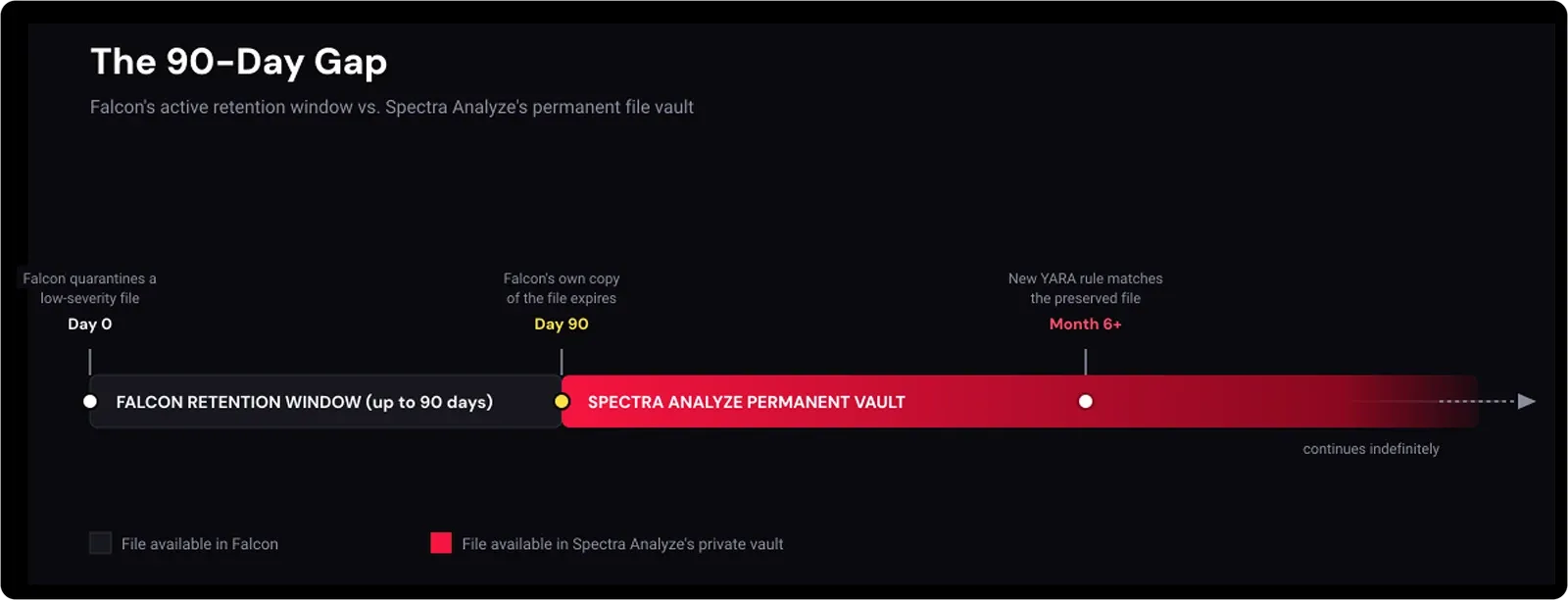
Falcon's up-to-90-day retention window vs. Spectra Analyze's permanent file vault, which continues indefinitely.
The base tier most teams start with is narrower, and reasonably so, since it's built for fast triage rather than long-term storage. With Falcon Pro, CrowdStrike's own pricing page notes that detection details are accessible for up to 90 days, and the underlying file may be retained locally for an even shorter window. That means a file that looked unremarkable when Falcon first saw it, or the record of it, can be gone by the time new intelligence proves otherwise. Falcon's built-in analysis is point-in-time and covers a narrower range of file formats. Spectra Analyze extends that coverage with automatic classification updates, including lesser-observed formats Falcon doesn't analyze.
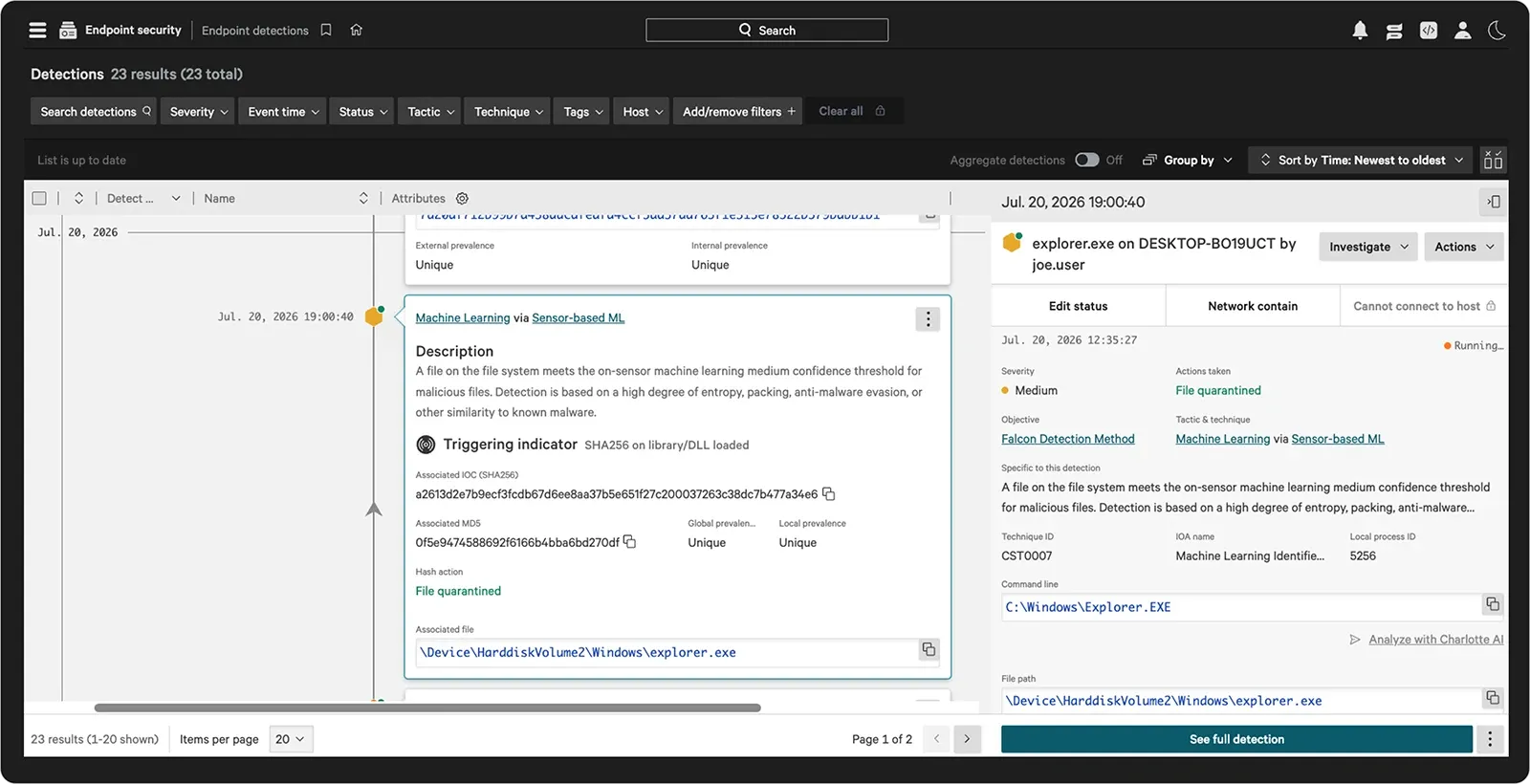
Consider a file that Falcon quarantines and flags as low severity based on reputation. The ticket looks closed. But reputation and quarantine only tell you the file was suspicious enough to isolate, not what it actually does. Weeks later, a new YARA rule or a new piece of public threat intelligence identifies that exact file as part of an active ransomware campaign. If nobody preserved the file itself, that link never gets made. The team finds out about the exposure from someone else, or not at all.
MDR provider Wirespeed made a version of this same argument in "My MDR Doesn’t Mimikatz". Credential-dumping tools like Mimikatz are "late stage" indicators: by the time one shows up on an endpoint, an attacker has typically already achieved initial access. Treating the detection as resolved once the file is blocked ignores what got them there in the first place. In that same piece, ReversingLabs’ file reputation data is credited with helping surface an endpoint security alert as late-stage malware that could otherwise have been dismissed as routine.
This is the scenario ReversingLabs Spectra Analyze is built to prevent.
ReversingLabs built and supports a live, admin-configurable Spectra Analyze integration with CrowdStrike Falcon. The connector is available now and was released in Spectra Analyze v9.6.0.
Here is the workflow once it's configured:
No analyst has to manually pull a sample or pivot to a separate sandbox.
Figure 1. CrowdStrike Falcon alert before enrichment — show a Falcon console detection with sparse initial context (e.g., low-severity reputation flag, quarantine action), matching the example described in the body text.
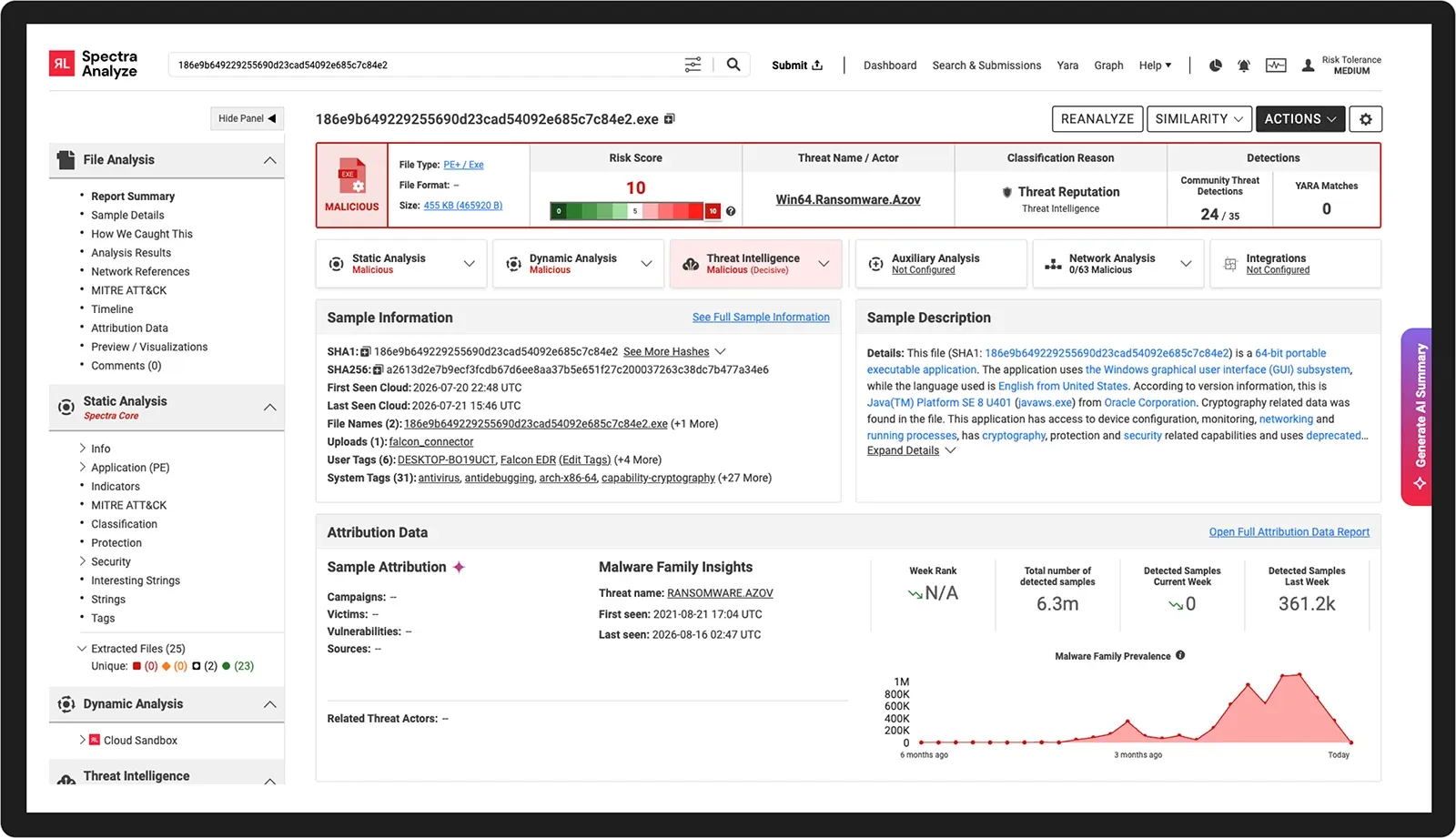
ReversingLabs runs reputation analysis, static analysis (structural inspection without execution), dynamic analysis, and full sandbox detonation, then checks the result against a threat intelligence database built from 450 billion+ validated samples.
Figure 2. Spectra Analyze file analysis report for the same file — show malware family classification, MITRE ATT&CK mapping, and extracted IOCs (C2 domains, dropped files, registry changes).
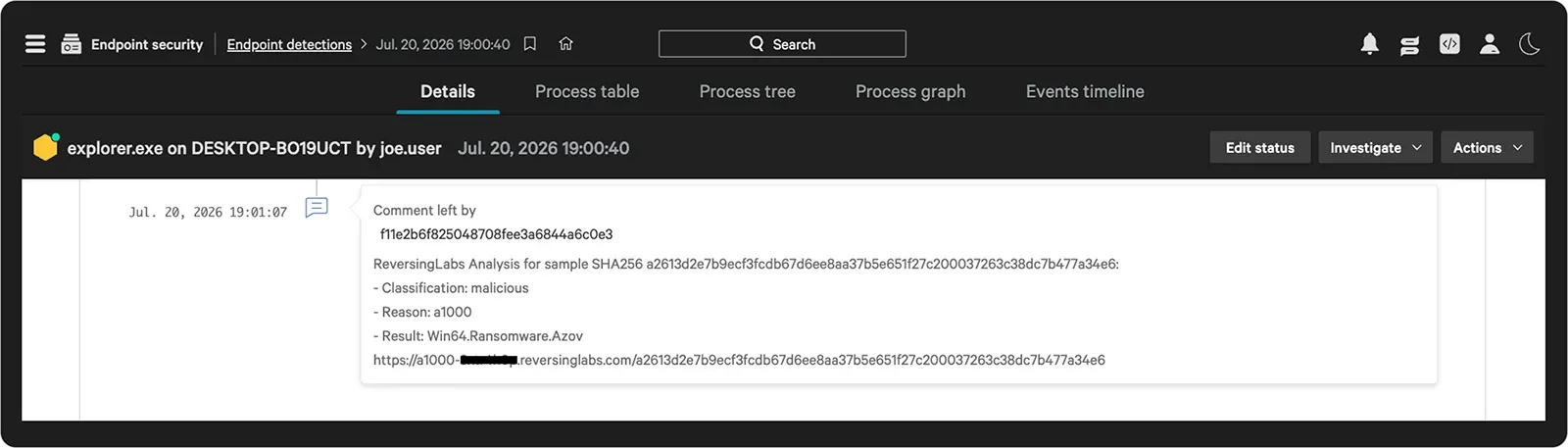
Using the ReversingLabs Browser Extension, analysts see the malware family and extracted indicators in the same alert they're already working, with no tab switching.
Figure 3. ReversingLabs verdict appearing back in the Falcon alert console — show the same alert from Figure 1 now annotated with the Spectra Analyze verdict, confidence score, and malware family.
Not for the length of Falcon's retention window. For the lifetime of the customer relationship.
That last point is the one that matters most for the reclassification problem above. When new intelligence emerges, whether it's a fresh YARA rule, a newly disclosed malware family, or an indicator from an active campaign, teams can hunt backward through every file Spectra Analyze has ever seen from their environment. Falcon's own alert history doesn't need to still contain the file for that hunt to work.
Three things, concretely:
None of this replaces what Falcon does. It extends it. Falcon still makes the fast call at the endpoint. Spectra Analyze makes sure that call has the full file behind it, in seconds, with nothing lost when the retention window closes.
Falcon’s behavioral detection and Spectra Analyze’s file intelligence solve different problems, and both matter. Falcon answers "what did this process just do." Spectra Analyze answers "what is this file, what else can it do, and will we still be able to answer that question in six months." Pairing the two gives security teams a second opinion that doesn’t expire when the endpoint’s telemetry does.
ReversingLabs and CrowdStrike are also both founding members of the Agentic SOC Alliance, an open coalition defining how autonomous security operations should work across vendors rather than inside a single platform. That's a story worth its own article, coming soon.
Explore the Spectra Analyze integration documentation for CrowdStrike Falcon to see how the connector is configured today.
How Long Does CrowdStrike Falcon Retain File Artifacts?
It depends on the product tier. CrowdStrike's Falcon Search Retention add-on can store platform data for months or years. The base Falcon Pro tier is narrower: CrowdStrike's own pricing page notes detection details are accessible for up to 90 days, and the underlying file may be retained locally for an even shorter window. That's enough for active investigation, but too short for retrospective hunting once a file is reclassified months later.
Does This Replace CrowdStrike Falcon's Own Detection?
No. Falcon's behavioral detection at the endpoint is real and effective, and ReversingLabs is a CrowdStrike ecosystem partner, not a competitor. Spectra Analyze runs alongside Falcon as a second-opinion layer, adding deep file analysis and permanent retention on top of Falcon's fast behavioral calls.
Is Spectra Analyze a Listed Integration on the CrowdStrike Marketplace?
ReversingLabs has built and supports a live, admin-configurable Spectra Analyze integration with CrowdStrike Falcon today. It is not currently marketplace-listed.
What Does "Second-Opinion Verdict" Mean in Practice?
When Falcon flags a file, Spectra Analyze independently retrieves and analyzes that same file using static analysis, dynamic analysis, and sandbox detonation, then automatically pushes an authoritative verdict back into the Falcon console. With the ReversingLabs Browser Extension, analysts also see the malware family and extracted indicators inline, without switching tabs.

Explore RL's Spectra suite: Spectra Assure for software supply chain security, Spectra Detect for scalable file analysis, Spectra Analyze for malware analysis and threat hunting, and Spectra Intelligence for reputation data and intelligence.
AI-powered security researchers gained access to sensitive Anthropic business systems through third-party applications, highlighting a growing enterprise security blind spot.
MFT and other trusted systems collect files, access and connections. Patching and inspecting what moves through it are separate defenses.
ReversingLabs identified and classified the malware weeks before the report was published — showing why behavioral intelligence and historical telemetry matter in the AI age.