Spectra Assure Free Trial
Get your 14-day free trial of Spectra Assure for Software Supply Chain Security
Get Free TrialMore about Spectra Assure Free TrialHighlights
ARTEX is an open-source Agentic Offensive Framework (AOF) that hands the work of an intrusion to AI agents. A developer known as Autumn-27 pushed it to GitHub in July 2026 as a tool for authorized security testing: an operator sets the objectives, and planner and worker agents then run tasks in parallel across targets. Attackers adopted it almost immediately. The FBI dates malicious use to at least August, and the developer pulled the repository on October 8 after reports of abuse. After deletion, forks and archived copies kept it available, with more than a thousand consoles found exposed online in early November. Adversaries using it so far are mostly financially motivated criminals and China-nexus actors, with reported campaigns ranging from South Korean financial firms to the ConnectWise Cloud Backup supply chain compromise. Some of these intrusions went from first contact to privileged access in under three hours, according to Microsoft's October 21st report. What makes ARTEX significant is not a new exploit. Powered by its norma LLM orchestrator, ARTEX spins up autonomous planner and worker agents that run in parallel to chain together known weaknesses, executing tasks faster than most teams can respond. To counter this dual-use tool, defenders must look past file signatures and focus on tracking the core capabilities and shared infrastructure that unite its various deployments. This investigation maps 11 fork-families sharing one engine, deployed across 3,147 unique IP indicators (3,096 actionable after triage) and corroborated by 184 operator binary samples. That map is not meant to feed perimeter blocklists; it is how we prove that nearly a dozen rebrands share a single underlying engine, while giving defenders the hosting context needed for retroactive log hunts and alert triage.
The infrastructure map in this report started with a dead end: trying to prove that two 1x1 images inside the binaries were victim-side tracking beacons.
Early static analysis of the binaries surfaced two suspicious embedded images: a 1×1 transparent GIF (ef1955ae…, 42 bytes, present in the majority of samples) and a 1×1 PNG (6b1048f8…, 68 bytes, found in RuoJi6 builds only). A 1×1 image is the classic shape of a tracking pixel. We treated them as candidate victim-side beacons and went looking for their handlers.
It wasn’t there. No pixel-serving or beacon handler exists in any binary. Both images are front-end placeholders baked into the packaged Next.js/Turbopack console UI: the GIF is assigned as an img.src for a hidden 1×1 used for font/size measurement. The PNG is a data:image/png placeholder inside the console’s bundled “file-browser demo” dataset. All image/gif and image/png references live in the operator-facing front-end JS/HTML. They never leave the host ARTEX is running on.
Disproving the beacon theory meant extracting and hashing every embedded image to account for all of them. This process revealed that ARTEX’s control panel favicon.ico is embedded raw as Go embed rather than encoded under base64. This favicon is a 15,086-byte BMP icon, sha256 8b567c02…, MurmurHash3 (mmh3): -576220750 and Next.js build asset path favicon.1uboyqwm7-s27.
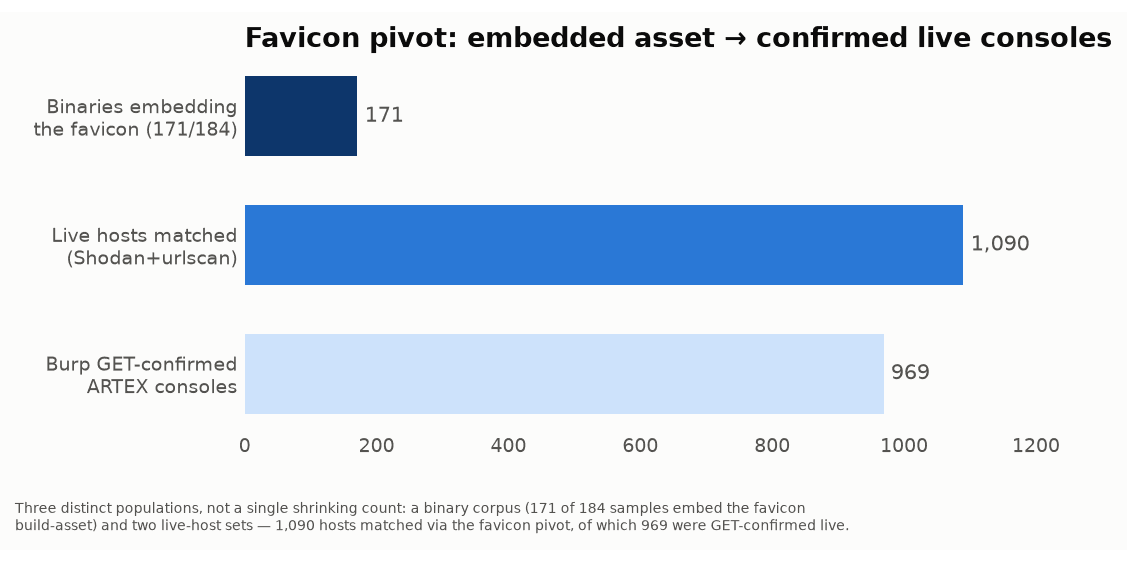
That favicon became the backbone of the hunt. It is served by every fork’s console except AntiFox, which rebrands to its own raw-PNG icons, mmh3 -1356779733 / -397770841. Pivoting on the original ARTEX mmh3, -576220750, in Shodan and the sha256 in urlscan.io expanded the IP pool far beyond the original OSINT seeds. However, many of those OSINT seed IPs lacked any headers or control panel response content that we would need to identify the branding or fork of ARTEX. Therefore, a proxied Burp GET pass over the previously-unseen bare IPs confirmed 969 live ARTEX-family consoles by their favicon and panel titles, turning raw IPs into attributed, file-linked hosts. Favicon variants, ARTEX consoles serving a non-standard icon, became their own pivots, surfacing a handful of hosts the primary fingerprint missed.
Figure 1: Favicon pivot: from an embedded UI asset to confirmed live consoles
The best pivot came from a disproven hypothesis. Chasing the beacon theory to ground forced a complete image inventory, and the inventory contained the favicon. Favicon hashes are provided in the IOCs section at the end.
ReversingLabs consolidated 3,147 unique IP indicators from vendor OSINT (Amazon, Censys, CrowdStrike, Microsoft, Cisco Talos, MalwareMustDie). The pool of indicators was extended with self-sourced Shodan/urlscan favicon pivots, and IP addresses yielded from Burp recon. Triaging these indicators to remove ones that are inactionable (Cloudflare fronted, VPN, or residential proxy) results in 3,096 actionable IP addresses which are included in the IOC attachments to this report.
We corroborated the network segments found by Censys: PEG/Yancy. These segments run 99 to 100% malicious, according to ReversingLabs threat classification.
The actionable IP addresses clusters into a small number of providers: PEG Tech (497), UFO/B2-Net (246), Yancy (243), Tencent (233), Alibaba (215), UAB Host-Baltic (107).
Florian Roth @cyb3ropsThe detection guidance should be what we've been telling defenders for decades: detect malicious behavior, attack techniques and traces of compromise.
Although many flavors of ARTEX exist, the same detection strategies apply across most of them. Below is a breakdown of their associated capabilities, clustered according to which fork of ARTEX expresses said behaviors. The headline is that all 184 Go samples import the same core (github.com/Autumn-27/norma) plus a common dependency set. We have included MITRE ATT&CK identifiers where they make sense, but some modern, LLM-based techniques may not have a formal code assigned to them yet. For these, we refrain from shoehorning the technique into an existing code.
Autonomous LLM-driven operation orchestration (norma): Rather than relying on manual operator input, ARTEX uses the norma core to delegate multi-step intrusion tasking to autonomous planner and worker agents. From a detection standpoint, this workflow leaves behind log records in distinct bursts rather than a steady stream of activity. Because the framework relies on an iterative input and output cycle that pauses while the LLM "thinks" to integrate data captured from the previous step, execution happens in waves. Defenders can hunt for this stop-and-go cadence by looking for tight clusters of process and network events separated by brief processing delays.
Randomized mass network-service discovery (projectdiscovery/blackrock) (T1046, T1595.001): ARTEX achieves high-speed port and service scanning across all analyzed forks by importing the projectdiscovery/blackrock Go modules. This capability implements a BlackRock cipher (modeled after masscan) that shuffles target IP and port combinations, allowing the agent to probe every address in a defined range once in a pseudo-random order rather than sweeping sequentially. Because this randomization avoids linear subnet traversals and consecutive port hits on a single host, it often slips past legacy IDS thresholds tuned for traditional vertical or horizontal scans. Defenders can detect this activity by aggregating netflow and firewall logs across broader subnet blocks over extended time windows, hunting for a single source generating high-entropy, non-sequential connection attempts with a high ratio of unanswered SYNs or TCP resets distributed evenly across internal or perimeter address space.
DNS, CDN, and infrastructure reconnaissance (dnsx, cdncheck, retryabledns, miekg/dns, publicsuffix-go) (T1590.002): ARTEX builds an automated domain and perimeter mapping pipeline directly into the binary by importing dnsx, cdncheck, retryabledns, miekg/dns, and publicsuffix-go. Using these dependencies, the framework parses root domains, resolves subdomains at scale with fault-tolerant retry logic, and checks whether target infrastructure sits behind a CDN, WAF, or cloud provider to identify exposed origin hosts. Detection requires analyzing the target organization's external-facing authoritative DNS logs and edge network telemetry. Defenders can hunt for this reconnaissance by looking for rapid bursts of diverse DNS record queries (such as A, AAAA, CNAME, and TXT lookups) originating from a single external IP address or a concentrated cluster of foreign resolvers. Furthermore, organizations should monitor for sharp spikes in NXDOMAIN error rates indicative of automated subdomain enumeration, alongside rapid HTTP probing at the network edge designed to map out boundaries.
SSH remote-service access (golang.org/x/crypto/ssh) (T1021.004): ARTEX facilitates lateral movement and remote command execution by integrating the golang.org/x/crypto/ssh library. This standard Go module allows the framework's autonomous agents to programmatically authenticate, establish encrypted tunnels, and interact with SSH services across the target environment without relying on native system binaries. Because this implementation uses a Go-native stack rather than standard OpenSSH or PuTTY clients, defenders can detect this activity by analyzing network traffic for anomalous SSH client identification strings or distinct cryptographic fingerprints (such as the specific order of proposed Key Exchange algorithms, ciphers, and MACs during the initial handshake) that deviate from expected administrative tools. Furthermore, host-based SSH authentication logs will often reveal machine-speed credential stuffing or rapid successive logins, followed instantly by automated command execution that lacks the natural pacing of a human operator.
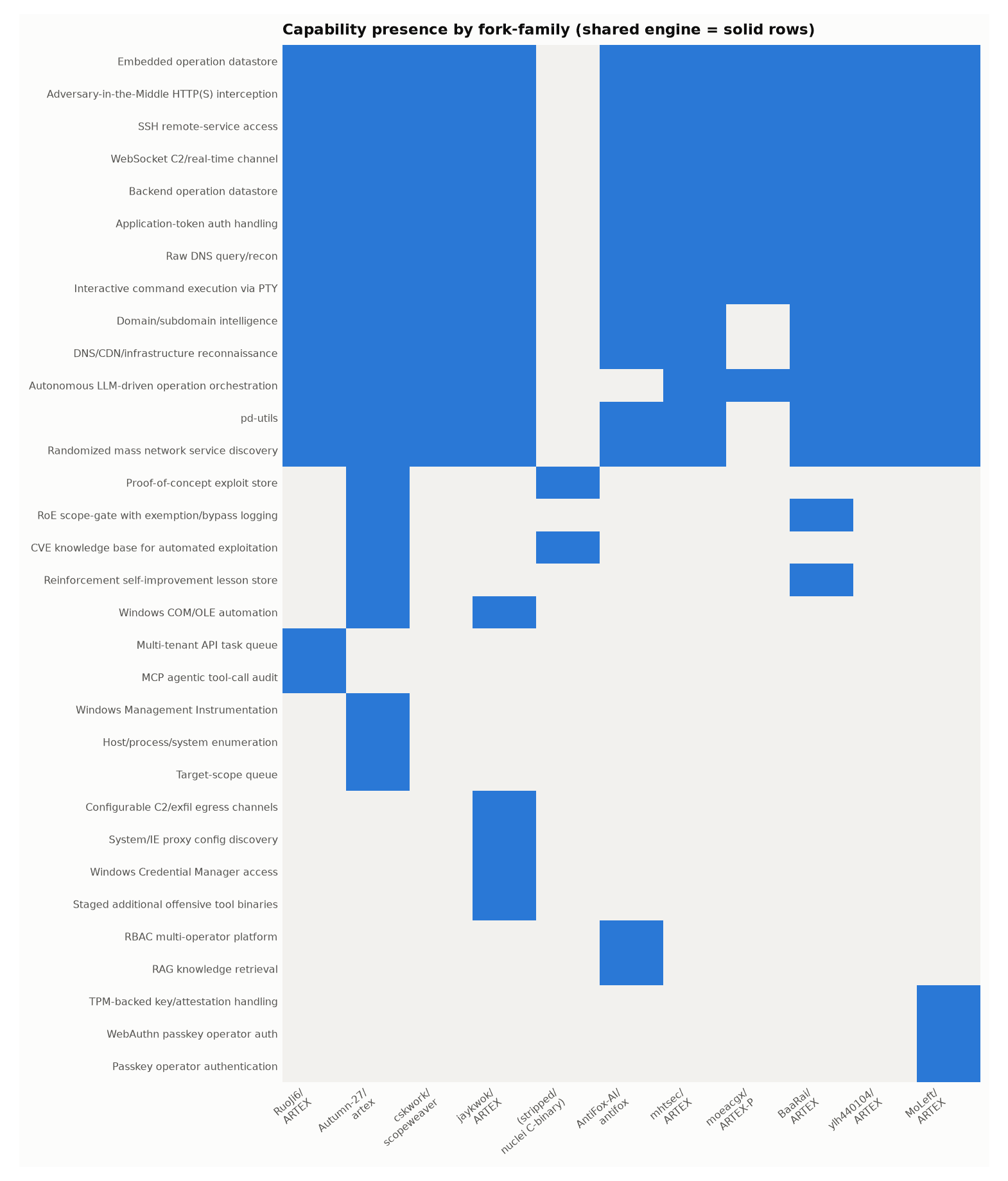
These behaviors are common across all ARTEX forks, so they can be leveraged for detection. A static Go binary of approximately ~40 MB in size which embeds a MITM proxy, PTY driver, the ProjectDiscovery recon suite, and an embedded SQLite console DB is highly likely to be an ARTEX variant. The chart below shows the capabilities that appear in almost all forks at the top with the almost solid blocks. The capabilities deltas in individual forks is shown below that in the sporadic blocks.
Figure 2: Capability presence by fork-family; shared engine rows are solid across all forks.
Although many opportunists have rebranded ARTEX with little-to-no modification, a subset of forks presents no attributable name or brand. Some use HTTP auth wall strings like 401 Authorization Required, or 403 Forbidden, and some use bare numeric titles (such as 06, 08, 108…). Still others dub themselves generic words (login, console, test) in a variety of languages and sometimes using language specific characters. At least one spinoff is attempting to disguise itself as benign by using the phrase “Sign in - Google Accounts.” Suppressing or faking panel identity to defeat title-based hunting is itself a technique (T1036 Masquerading; T1656 Impersonation). This is another reason to pivot on binary/behavioral signals rather than panel strings.
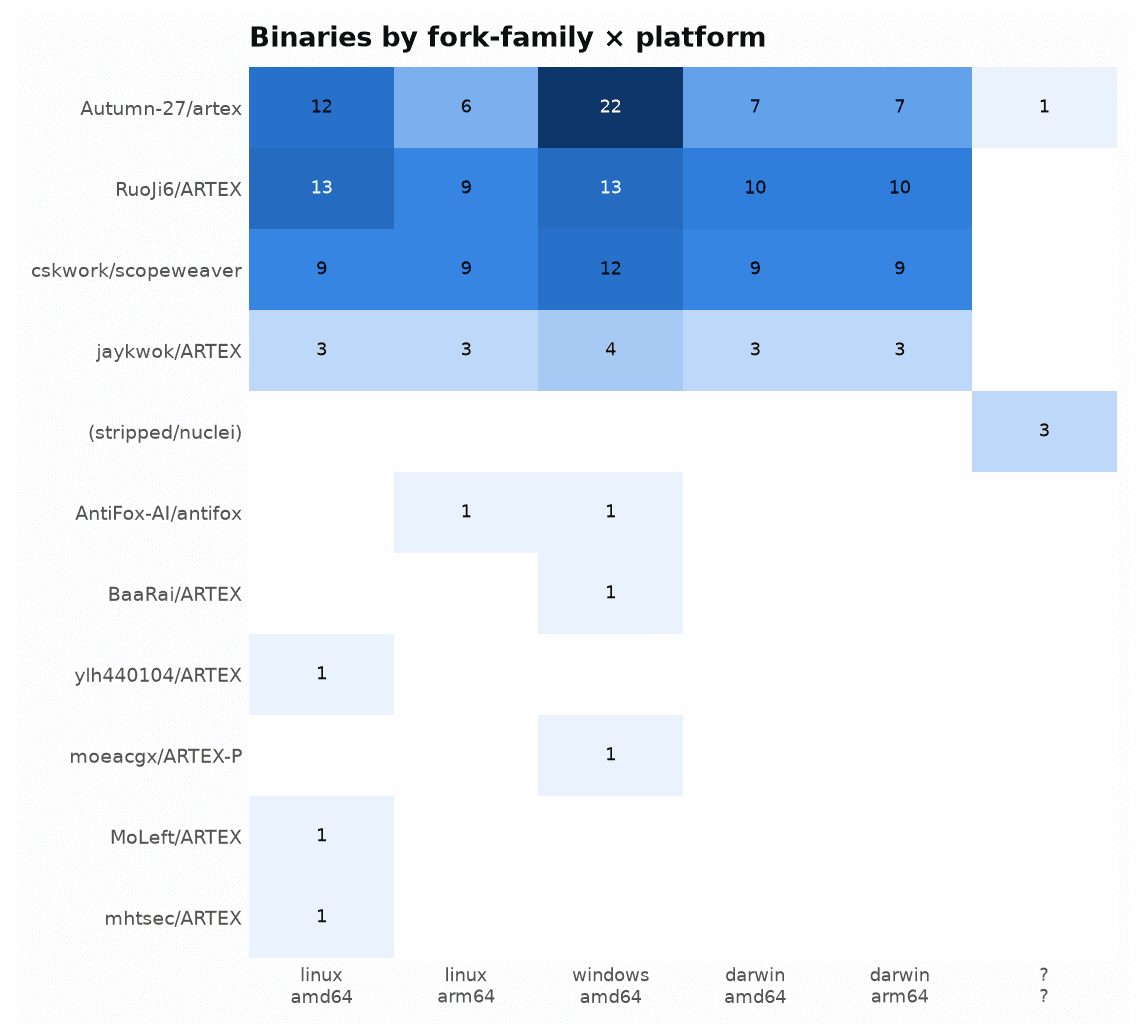
Supported platforms across the 184 binaries analyzed for this report are broken out by ARTEX fork in the figure below. The pool spans 72 ELF, 58 Mach-O, and 54 PE binaries distributed across five OS/architecture combinations (linux/amd64, linux/arm64, windows/amd64, darwin/amd64, and darwin/arm64), alongside four samples with unidentified target architectures. Four fork-families (Autumn-27/artex, RuoJi6/ARTEX, cskwork/scopeweaver, and jaykwok/ARTEX) have builds spanning all five platforms. In terms of sample volume, the original Autumn-27/artex repository and RuoJi6/ARTEX tie for the largest share of observed binaries at 55 each, with cskwork/scopeweaver following at 48. The number of builds, forks, and rebrands is growing on a daily basis in a Cambrian-esque explosion. This reinforces the idea that detection of capabilities and attack techniques is primary.
Figure 3: Binaries by fork-family and platform.
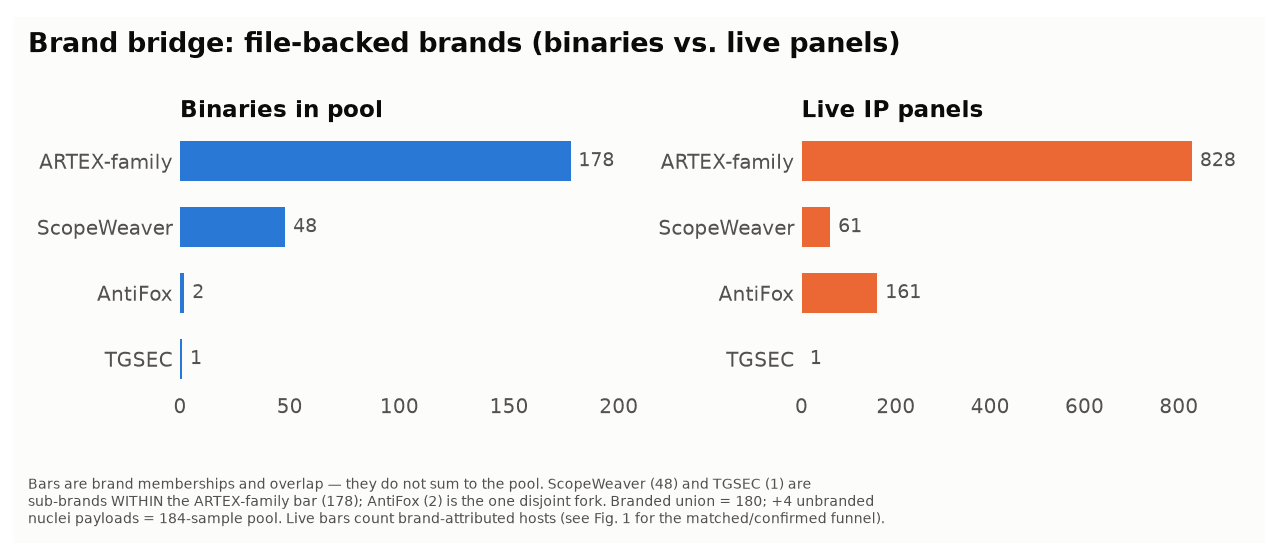
As previously stated, ReversingLabs reviewed 184 ARTEX-related binaries. Many of the rebranded ARTEX forks have not made any changes to the original ARTEX package. Only the original package, plus three additional rebranded forks have both a live panel population and binaries that embed the rebrand. These are distributed as shown below.
Figure 4: Brand bridge; file-backed brands: binaries vs. live panels.
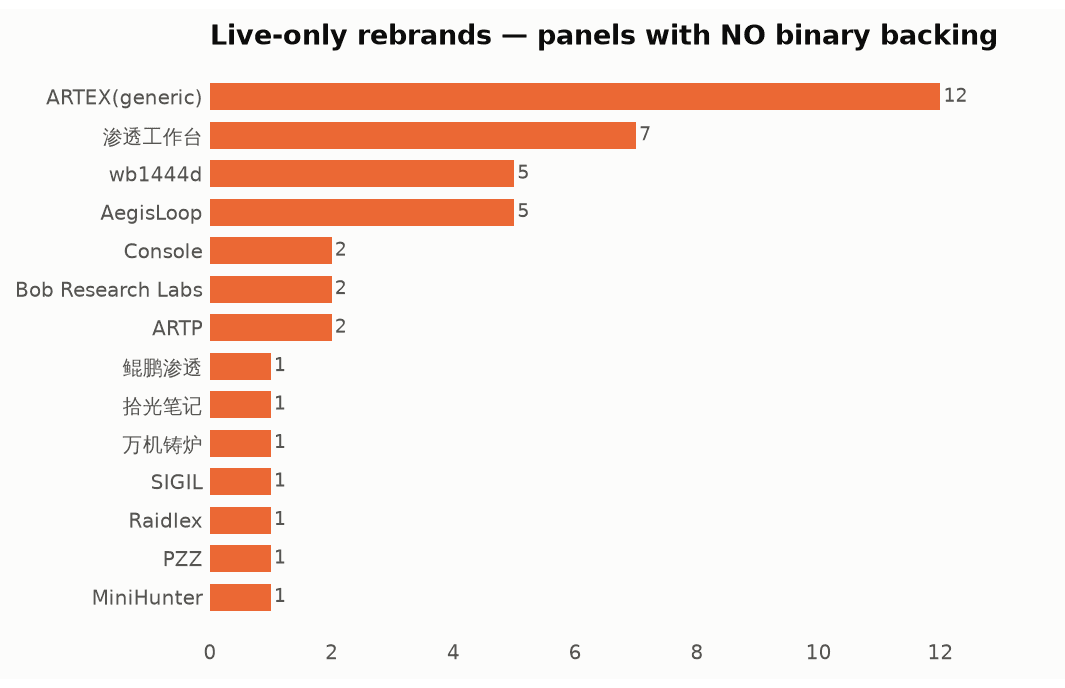
All other rebrands are live-panel only, as shown below:
Figure 5: Live-only rebrands.
Because ARTEX operates externally from attacker-controlled infrastructure and routes traffic through commercial VPNs and shared proxy pools, defenders will rarely observe the ARTEX binary itself on victim endpoints. Effective detection relies on identifying the framework's distinctive HTTP fingerprints, LLM gateway abuse, and time-windowed network indicators within the target organization's own telemetry, paired with hunting exposed credentials and hardening management interfaces.
When you scratch the surface of ARTEX and the 11 fork-families identified by ReversingLabs, you realize that the concepts implemented underneath are remarkably boring and bog standard. Despite the Cambrian-esque explosion of rebrands, evasive panel titles, and minor feature deltas, these new Agentic Offensive Frameworks (AOF) simply package a set of red team best practices straight out of a SANS class or a Phineas Fisher post-mortem technical write-up. At the core of nearly every variant is the same shared engine chaining together off-the-shelf reconnaissance, proxying, and lateral movement modules to exploit weaknesses defenders already know about. The real differentiation is that the AOF is wired directly into an LLM, injecting the intrusion process with the advantage of machine speed. Instead of a human operator manually running scans and weighing next steps, autonomous agents execute in rapid, iterative waves that can collapse the timeline from first contact to privileged access to under three hours. Combined with operators hiding behind commercial VPNs and shared proxy pools, this speed and disposability render static binary hashes, permanent IP blocklists, and fork-specific names largely ineffective. Here is the catch: because these frameworks automate standard red team tradecraft against known weaknesses, the mirror irony is that defending against them does not require futuristic AI countermeasures. It requires taking the "top four" or "top ten" security controls from a decade ago and actually implementing them to the level of best practices. Historically, organizations survived incomplete patching, exposed management interfaces, or sloppy credential hygiene because human attackers moved slowly enough for defenders to catch up. Agentic frameworks remove that grace period. When organizations lock down administrative planes, keep secrets and AI assistant credentials off exposed surfaces, patch known vulnerabilities promptly, and hunt for the behavioral fingerprints of automated execution, defenders can take some of that leverage back from the LLM.
For IP addresses and their sources, download the CSV at the link, here.
ARTEX console:
8b567c0244f2dbee787165aea9c4ddabaaafb0fdb3b29899ac898c60a589856b
AntiFox 256:
68e261808e123d7f33675acac8ca66132fcbc4e4c70a11c5b76487736b221c68
AntiFox 512:
3e8f0d584403e3ce6793f8e6041f8b1ebf8c987663ff83aa189d883c6e475cc6
ARTEX variant icon (ARTEX-titled):
c5f96fe44bb95f24efe844a2c8f492501a28ccedf57c1fd488b707c0e2cc1eaa
de-branded 'Console' cluster:
55efde710accb5b818af94a1c6c29f00a865e89f0719692b76585d44fce14168
Raidlex:
445c165a11d9ab41d11cd50cf446f69e138d827bea4f6ca5f4907968a57f668d
ARTEX variant icon ('artex'):
63a35d14f74313299a1f79a5caea4b74f88ba77734234aace15b512db79ff808
ARTEX variant icon (ARTEX-titled):
90e20973d4fbdc7b30b700d05777e233d44958eec8cfaa4759872b351f6f8907
Lone svg (no title):
7836c216bebc774fa86de522a00b78c8b80f8e2da3141fe79d1d454289f98a84
001eb437c20805fb94e8e7014c019318f0f3186bc0cd2ea3508245aafbf0c248
014154af33662f55901a20902b9deae23a63fe3817fad44a2718f6e30e7a9cb1
01edf9d0f41a7f527c935bb95974402cf1667635e32111b063eecf8b19f0e322
047da1e769cc583b2f697e9d6c5043b8aa004a7bff4870718850900cd64836b5
04f1f1c54918c16db83d82362a8bd14a2ad9441b5654627889d96a8b7a2d33dd
0640d39ec254fffea1c2aefe3d44659ba31dc9dd62db75d0b0ab480592ddd619
080a0c302f4ed5499ad9cbedfd8dfd1e10d813351774b35884d8c088ba705410
0a43907be0bec39e8e17da86eeb681eaee68e4d3d2dc527e58f4d7590833ecfd
0c7f958f59af463d81a158400e254a87a68855ba8c30d9939d299dfb82ec59b2
0c84527c81534d06f31acd35a498e7f7df71110034dae34b3171f57b169780ce
0ced4f0ae55582381d810f07cb21101d3e25cfbc915e9890547e728c5cbc19fc
0ec720ed1f51fa8522a5f0cfecfa71e449141baaaad194ecf9bb907aa291079f
0f8b606b7532d04d4aa36a6339777b9cbf6f320cc700d90a67f580f75b3c9843
0fd9bd3adcaccd65e7dae5e37dbbdb352c37a753298458065ac11f4f6e548c0e
0ff7ebc88eaf10679d67498ca0a4fe3f682a6abf6158a2c53e0ac0a54085d097
10318e642fdbf39e46800621bc27e0b7fdd2e23c562cdc5473998bc212dab034
14e8d3f73d03b745bd29b0a397aab157a37089f65f64519f836889e5c9219a49
15f2c050d974edc60298dc3555a3f6887a80d10853b611d1355cb2674844dee0
16f12d805d44cb6f0559451ec4a692069c37f0d118bdf7feabda6b9c32535a3e
18de42e9541c741aba1efef1885beaab359065e7139632dfbec151c7b7fe1093
1af499b6a896b591d0ced4d37f08f7e38a672b50fefce30dd0b74e39803a8ca6
217d03398123ca50ce0109f438897ebaaaeb207f6cda4a7bed0f63bbb15321c4
2345276e7d0fc9e5215c70a56b752d2f743d6171084ca2088065499788bc94ca
26c9c3a17dfe5a4882384492e9ecc6cd28646c159e8116d258a621cccee6b3de
2968118ecddff20b947466531a8079fd77686f57b41601993e17f62344fad353
2a0980fd128f21710f2dd43ccb5c6c48742741e9bb642a5ab32ce46aa6995362
2b2140cd6e30e2263963db48808ed0341108f067cdb725cd109215b1b54fa321
2be8e1a61aaa40092c92a91612fe8b9aacb0213aee20b97e67b14f863d83b77c
2c2a98f29116c2fe99dad2af20e0ba8f2e1c8ac0fe2fb29c20f9addada18adfe
2ca4d627ec984033938ff45dd70e31e7b8ccd6ef190f9a5a39c84d9fe913ae37
2d2b32c115c606e33cabd48e0b132e5515fd7bb33827ad17191fb37356a121b9
2dea5549a9765c1b9d8da5e5590af6bf631bdf05f7074365510c72b6ff11ec8c
2fcccfc4cb1e58a974bad00f148f2c057d8f4062633c9ee873612cbc6dfaf07a
337b310ea48d2d686e4ba1e4f2bfce4e04788e7db16be5b04f533950b4664728
341696595b5ff430b9b09c2d688a814062e50d4dee56cd823052a3a3426da605
34696f6a26b97fd056e717095c462117299c7affdcd58d514c9bf9419472c612
3604a12e4e13a3e6d8166dd999b9b1e0d981f0dafd2d3f6faa04f686d0f6fbf5
364acf32a9e5557efbe6c9b360f41c010f3450388bc8cc73c20c799697f8e92d
372b1611564b54d0e35b1c6e58d2ef94bca896fbf223dcbe9fd13c1bbc230938
37c6f69f8ab92d3fc2abc94f5205fa163576420d8fcd819adab8edc38722dadc
3906ce6f6662c12b72d61228a4d19ac9a55d922e8d90b339c8ae266e7ed02c04
3bc0bf20e659f2bc4d1b27c9b0b3e6eac77435b56caaf374dba8b90ee3f01793
3f5accc83f6b8c27eb0b30963be7a3b451bdc1b163980d2244f4367ee8fc069b3fcf1b94b41f27d293417898e1510ecae5d77c56ae403e39d299a3e2712ee5e142175ef6cece7c25b47ad293debdc350a851efe036de9fdb3c18913148eb03064477ce65f82ba53c85eb49af97c58fe7ed2cf263898761fcc85d6dffb3d3b0c544f8cb7983396bd788bed1d3050536e14b342fbc9533de65192e0d0621d7383e455d53c475366ad016aff75e86e91371533e0f5163d6d6a53790758b814940c04794afee2c4e96641eb5b54ea0c2cb2ac186e405c8308f2b6f3ba119434ef05f495a1158e29ae5b96242432a50b27363606d1fe9bad032c73d002c94853fbaf64ac8b8cafef2bbbb350f2c41355c6401fe016a4be316cf633f9cc3b5f643c4754b5feff5afee2d413a82ab223ae7584084897836ddc6596f5fa011034e8c57f24bc371ff77a10ee3c43619c7bd8eea182694274285b3edb2beab8f7ba334ba144bfab9628a112e9a15cd1268da9968c04632619f2cfa042ab4cf40d281bb51e54cab003ff6c1a18cd428dcc11c37dc17b2168aefe8a9ba24735a01fdd7adee354d007e9971b6ffd2ed34350216a30e891fc6fa20a8ebb0e8b5552273a58df1164f3799e957ec6e00f63c2718d137227f512a01cc6f93d0c1e4d49c3e45652085507633e1304ea900f88ca7a6ee2461e1a7bb2718ad99f9b540418ce1516e3f6054eee4274db92b85e7148d9581224b47f4badd283103661ae173034ae4eb07fd55c17d6c96471d33e8abc0e3d9e0a6554b2eab482179df78c250a47be991b42556a24823a14938524bba2238a6d4174425f775f0928859fcbdef8668d5f6ab7c58726beb0e7ed135a53c652a22397d40bb873316229ca5c533b8c34c7d544c3e5c51cb048a1fa56802c4efefe9eea04b04172322fe66999c463d517a2b15fb4d5f6da34f6464b9920739da02922c28d9ea7d4b45f6ac987060a3ad7846fe9510600147630d43f091c9e4abf7916d24f95fe4d6fdcc4e428b6bc3c50cda512a2a602182484171c55ad69dbc9005ddbd4ae39c820d4181d6c375a6bcd8c8c3721460a1ca983cb123ee648d69a7fa43060286851738d2b2c188711520f01d3e7a7d61d5057f69a4d73a4a0f88688ee8b4533f90adb04424c151703c1091b071958565e2198108b6a961badc5d2d9dde5bda5fe58288e497d22aadabf254dc83af97673c3cc9cf4d40c41b60d096117eec09cef50137195cf8dba6651f5a485837a06a2c4bc243fbd74737ff8c10e7094e8222bffbdb7c07161b68f640840956a7976b9f776b4be8a8ce7852a74113fc762da285fc719b3b7e37ec09e88094f342266c0420cd824db3b283171e4394e666ce8a4380987523a71f336c027b89161d3b6d9b1a208a404c0b21a0dba2dbad29f3371258f1a38b1bb97fe6548c810fda126db39fae89463d741a49bfe8bd7b791e470c0eef566d290a32b00a7018c4626c6ef8e26d864d2bee25c6f9fce8d6061f621ddf8185e0f80cb041419288c4a24b701777f3ee7e1c35d0aa38f2718474103da5158eb2d75e0dc2c2b74b3a80d4307062c0b95eaef75058ea1c8cc45e2819e182bd7a1b0cffdd0fe97ec4c986fba4706d9498536950d76004b887a13c5ef4cfdd9c480161e17a91eebcf702dc021171c8ef5ab8c46ee1a50217965401dc5f9cf70405934d671fc67797e6e6b0e3db7334945ba09f88394ae7fc528a8ff9d065871d87da77d5c12db678c5da02372c75d31da701fc318378c865d16f95c93c4e009d477d0fd87c80387aa0f6842cfe779c8e219b439918eb6c1baad364a36a7fc2ce66385feff4cd0b51dbfc6bd23678f6f08bd9bc49967aebd41e7a75807059a810f88cdc832cf89c7e800df0ebda796abe4536c19dcc331c2187035bd95d1eb7d5f336677f7c0f97ad83ba417bda799804d28c26129f5ce8788ffeeb5d0f36fafae0a3383e3efa9bde8f82bd22717a600f4c756d88cbbade4631fc4a80e5f594dbad4cfbb82dc26c26ccee6f17567bf0cb8dfd5073d3b02668991203f6fdc3ef55c8c730e5edd3274be3d32967bd7ca0ad5573a46565924735267a2ef7d9d72f2705bdd3ae717155d20f2fee631b7dc7d2b965282409c1c58d5439ecdf38f6e65879f1b79d20ee7d196967038d2b8016d0225590c620fc9652ba80d2892fb030ee6c1ac31dfbdd389aa1d624ac408090b025cc81f3e5fa076711fcf9f6f2224238c23e593a389b9744c03c6dc991835c715128fad6ec94bee00b042ec5cbe9d63be2dc12d04cada2163047e59d5b83744c0ba61a6cf3fc576a36528bd649be6d44d72180086fa5f980cf2841119b84aab232b137c771de8ebf5a0eec7a60b9ccfc9dd8722680b2cf2e3a1161e98e858ae5c78c2bb99d7a46ecc379fe2d0f969665dfb0e55e4fc268076bbc38555988fc27302d17b977b0d6665b1543dc53c4c71c8e5b96e583d4bbf94c6470de438a910f4c99479901d44c92db19e81cfb2d9df1155583dc952500ebc31d79af658c46c5792ed05ae517e2e1ea57a6ee0895caec30ccfe0457e415039e54c423778cb632aa6573d5db720ad0ac59410dcd880f9492b70e15e64149bd20c2c4280b8df39b7a366662c28666c756ae1279478ae6c0339e509bdaa2186d35e82fb0ad91213edc0a550c45eb3b31bf6cbaeabf7ea8e7a9faf0030c0d79038dc0fb3946925960071dfb177c94ab407b99508ae593a7ffecaf22247e1a81f43b55f148f892f540f4b2f13c33d156e1152e914ae95c331ab6834c15992e96a3f89d5c84c694e11934292238add948ea7b3aaa94d24b42b05137f7ddfc3351a70cbf48a51a94faea0373d30035c2e77503cbcd7c7badc962ea49eb113a3b63c448a12de39e9898059220380ff443302c831963f0be892e481fecd6f601edcd74193699759a9a150e662ce706ba4841abc75b73575c669bb527c2a5f549aded0eb07675e4fa9c05e1166c78e1ccd135e7d6e46dd552670245998302fa66939f7088984186479c3bfef4d3bf1b4406bdffba710a28420fbef59d88b96ae1fca8068fd7fb8e659c74f5935dc2ece9e3e52c21d9e243bb6bbd6f6f8f519e6343df2c5a9d88ebbc9d24eab373c521969a9373ac0b87e75dc38e95951fca32c698ed9175491938199e59b455ca368761f6d07a2c53761b6d39b99472391ad59c3445b1c704f75b8ca0e245e278d1f6452fe15cb3a389a3c4a8284b2e8846e7dee6c14557861b82d0a2d03840a8f673c11cee82cdefdc515e90fc68d27e0093b508220b39342d9f9aa3479ff2a1b869727ba52c6241de9f84d1a0838e38621eab608f1ac0699f1d61a3ce7bb27632c049be2f91cc318ff4b5c5cbd34ff23d2b7fbfc083f266e20890a4043d79ff73b1453897fcfb5d6d4c2abbe5b1992d88ca10fa86767e008b296da436b79646c9bf1571af6df86a3768862e15158d729f3945bb2de21a231615dda5ff047fafeb8d4c919fb4da7bd5bef813bec776a01c07f4ab0e88477ea4121da7113a383baf704783e5778081330e592a849f07abb71029d35415a4e7794a73aa0a1d841e2eda0e008beb0ede43437342e2b5dab18aa6d2bf856efc17ca2a54aa54a99b11c8e14d9d8c6b611d2eeb3415be497b1bb3464cd9b24bb6acaabf11ab5d2733502c316ab38b6a5cfad6041967d2f099417d3db385a6acfb77245461add41c81346653f0f21ec54b3ffb23c5722f5a18ec82ced767616bfbf96d27acb0d21afa26de8ea6ed7edb6b6d820716624a2dc20070fa44652c599e139cd425b14c0d1fe8d8b4e516f25b4d10501c53ae93c8b76cd525d911f1548facbe5529b1871724bc3cd7778e2613662f23b7e1ebd3ee6131d5ab0fd2053dd23b7b04a5b243b5ae4c96b6139bb801c81a5251066b012fcb362d6c4dd0d7cf02960d580eb441e34c8c1d724686533b700494e2dfe68b5d1f2bb9d6d5ea6080616c88780db4692f5b3eda0b3bc5eaa2ee733bceb186af4564aa39f454adc5f32e3a902adbb576d0f470836626a46141565ddbce91af910beeef68354888b0b0a09ce71202bc9b1bc95fa8c9b111c2bb95e5e35fbb6b75b4fb6d9d12900f3e4ab7190b36f6bd690c6064307b51c6643ad2c4e2ccc59c577c55af2b6cbbd72bfc26a751715bbdbc6c48b948e56de7376650d61e2d4a731f9e90eab24438a781fa78e4117dadc15442ab82856e62cd742bb3432fa421b116848fe1395d7b23d0b1ae3b87f7dbc21208e6c50a6bdc09d7b876147de3bd8dd64323dc9abba5f9998e3b1f7fe5b6c3499ae0e1fe2d6e6b0bdb47715987284700b891f0bfbd4b368484000da0ec4ec61ced2755714cf175c91ca72291d264c052808aa254b4ca9f3e7f1b1f98e245c6616765ce657255949d9d9f23fed616d1a1bc5fdc73cb5670f2e363fc0fcad1c6fbfe3fe19ab5a36db3355029d987bd723561138e0a388813a84873535c9363cc6e2711d9adbcf54db0edb2e35bd58abe3b1cd7b0aeede4e918736b2c71be80cce7e887604bdb99a23dfa31d931294e9289c2387badfc4edfa88c23416cb6c5cd540e70cd7a0339452377eb2c5d0e99d29c1c95370415b7d543f5075eb21727cdbaa9cf60159a1f0e367737b3a2463ec8be9bf49db219959c5fbd662582de1fceb757fb00444ff86ebc6b123e5eee78b19ec250bb8dff4bce94e35047b7e9f4cece90bcfb1acb44a29346d602088007872a1040775ffb5e6418c9cece6f4f69cf960b11517be5a0659016a5b8ed5b5ea788cb969ae9314656e402e1122a7335d38a75b3c241a6ecce6c9400f71b0e87bfa20230dfb0b9ec66e8c39753eff83ed5070f52262effe216b840711343bff8f2787f39208d887d8dfd9c673f8d1573d5c393ee91a52377df0485f1d082280c11ddf8f2302f558d4a63792434ed1ecad64c7ca7944f38d47e162db8813463f0d5f258dce9e839216220b1188422bf40d74616950ee8224028074b23e544f30d76e7e9746ac30a9d4a0b3638c3857af4d79309ad58d5889a865f001ab1824a47e602e9c129641ea1bc4361f5c1f28dbfd833479919740eb37194110c15e69466453320623170104be1f588c2131cdfe8d8e944a8487b317c51d2cb8e083f1eac6c0c9fcba1fc5dfcb8afb6b133071e7dd97f75c6049cb724f45a8e67efcb2e4f187fb665f4d7ff1cfe85e31352f27ce2db9fcde39d063f3a03a9a387e64cce82d6f06ca11ff442f82518a69a57b3ea13dbd37f380a5851b07f315b049b1d7f4c96024af6ac735a92340ee534b18d563edd8d5b29f59e14e728ac1e76d85593e64fa5dba83102212f8168c49ac134348cde4c14be3df2bd11dd6764582efd70c26851c02a49307979fb2d386e96487c57e01033a18e673e4d451415603b25de4240b23decc8af186e33a323fb41d4de1de07273e058f78098a8471ba60dad3c07c17f704ffc69e8839bbac02496861ba0e263204b9d527c8b9adb327fa4a1d42f9339265e51c7dc47d6c9a34304956843e2e6326e5ed2dffb93ce18646b97cfed13881cdbc499857ffd6f58e2b2534653e72001f93c1a0f7ee99dc324ff55cca77c72f7a3c6d90aa1ba58057142b4ca84e8373decf467e1fe2535372f69fde6b706b131dda67da986b9a7b4f0b9290450ea0c689b4e27af5f25f916a76c2c7f0c88f9bce161cc833a2b736055066303caeb4daebb55c749a4e52b0f5543bd4b28baafc88623c2901af7732a8c480c62b9ebebac146650a28a52afc7820cb4bdced6f5d6fef06b99a258d6d4b486d69accecbcf4537bab72e6e440773e88eef0b96f9cc374de8b84f956685bc32496c44cedb6c5016843d312670c26432bdaec7d497d167490499e4beb9722eb2d90ba28ee1d15e80c277af4f7b9588fb3063e1d70ac23bf530634411f03e94d4a369e2bf1bce44caff928a9cc29d773e757f1f8cf74461b8597d64e3bcd2a129babcd1ff5ba4ba600d13508bff42c692c8928e15a56f5d64d0217b123ecd1c7d7992e3cf800cd76f1989cefb186bf5adabd77446e18afd91ce106c9cea69b70c0ceff13fb308542d2001e80d3acc44beb63e36f196799c0938dfec53df642a34164210bfbbe8d3864f10e518e815b5f1e4fbfde2ae25d15647b7de7c379bb9ebe3aefb5fc6684f563e0ceb629335419325898bcc996eac81e3d89f932e87bff6b92d77ffde0be013587a64cb06e17ef0617ae32f7676d981033da81dd70d917b6f85073fe30bfc2c1517de84618d38838d9731f7aa76571f4a34a01fc680a2496822b54feb9d6d6a34037c2821ffaa29bbc2820beb0a90424143ba00fb55d47a93672d9fef8e000dda1fb7100a2e8db823b50e908b341580bcee606c5e67066e5d65b87feffac4f40d717e8e70174b0199edeca9741ff30046bd737db5840c0c703272a

How a vulnerability in Optimizely exposed visitors of at least 178 organizations’ websites to malicious code, revealing a critical blind spot in third-party software trust.
As an early participant in Anthropic's Cyber Verification Program, ReversingLabs is helping advance a new approach to AI-powered cyber defense—combining frontier AI capabilities with deep file and software intelligence.